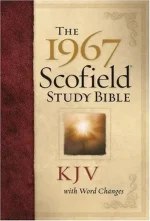
What version of the Bible should we be consulting today?

Yesua888

Well-known member
Joined
Nov 15, 2025
Messages
398
Reaction score
337
Points
63
1776580987824.webp

Were the Study Notes of the KJV Bible, the only version influenced Scofield edited translations?

No, the Scofield study notes have influenced far beyond the KJV. While the original 1909 and 1917 editions used the KJV text with added notes, the theological framework—especially dispensationalism and Christian Zionism—spread widely across denominations and Bible translations.

The following is a quick study of apparently how the bible has been altered over time:

What has the Scofield Reference Bible, Zionism and Christianity have in common?

The Scofield Reference Bible, first published in 1909 and revised in 1917 by Cyrus Ingerson Scofield, is widely credited with popularizing Christian Zionism and dispensationalism within American evangelicalism. Scofield's extensive marginal notes reinterpreted the King James Version to assert that the Jewish return to Palestine was a divine prophecy, effectively framing the modern State of Israel as central to God's plan and creating a theological mandate for unconditional Christian support of Israel.

Critics and historical accounts argue that Scofield's framework was influenced by Zionist financiers like Samuel Untermeyer and was designed to inject pro-Zionist ideology into Protestant theology. By promoting a rigid literalist lens that divided history into seven "dispensations," the text positioned the land of Palestine as eternally promised to the descendants of Abraham while largely sidelining the rights and history of Palestinians, including Arab Christians and Muslims who had long inhabited the region.

This theological shift profoundly shaped U.S. foreign policy and evangelical culture, leading figures like John Hagee and organizations such as Christians United for Israel (CUFI) to rally millions of believers behind Israel. While supporters view Scofield's work as a fulfillment of biblical prophecy, opponents contend it promotes a one-sided theology that exacerbates tensions in the Middle East, justifies racism, and undermines peace efforts by prioritizing eschatological speculation over historical justice.

How do we know that Schoefield changed the King James version of the Bible in 1909?

The Scofield Reference Bible (1909) did not alter the text of the King James Version (KJV) itself. Instead, it used the standard KJV text and added study notes, cross-references, and commentary—most notably promoting dispensationalism and Christian Zionism—in the margins and footnotes. These notes, authored by Cyrus I. Scofield, interpreted Scripture through a specific theological lens but left the biblical text unchanged.

However, later revisions—particularly the 1967 New Scofield Reference Bible—did modify the KJV text. This edition introduced over 6,500 textual changes to align with modern translations like the RSV and NASB, including altered wording in key passages (e.g., "a son of the gods" instead of "the Son of God" in Daniel 3:25). These changes were made by a committee after Scofield’s death and are not reflective of his original 1909 or 1917 editions.

Thus, while the original 1909 Scofield Bible preserved the KJV text, its 1967 revision significantly altered it, leading critics to argue it is no longer a true KJV or Scofield Bible.

Were the Study Notes of the KJV Bible, the only version influenced Scofield edited translations?

No, the Scofield study notes have influenced far beyond the KJV. While the original 1909 and 1917 editions used the KJV text with added notes, the theological framework—especially dispensationalism and Christian Zionism—spread widely across denominations and Bible translations.

Later revisions, like the 1967 New Scofield Reference Bible, incorporated textual changes aligning with modern translations (e.g., RSV, NASB), and the 1984 edition adapted all notes to the NIV, showing the notes' influence extended to other Bible versions. The Scofield system shaped evangelical eschatology regardless of translation, impacting study Bibles, preaching, and theology worldwide.

Are there older bibles on record, that have not been influenced by these Scofield note?

Yes, many older Bibles predate and remain unaffected by Scofield's notes. The Scofield Reference Bible (1909) was one of the first study Bibles to gain widespread popularity, but numerous Bibles existed long before it—both in translation and manuscript form—that contain no Scofield influence.

Examples include:

The Gutenberg Bible (1455) – The first major printed Bible in the West, based on the Latin Vulgate.
The King James Version (1611) – Published nearly 300 years before Scofield’s edition, used by generations without dispensational commentary.
The Geneva Bible (1560) – A major English translation predating the KJV, popular among Puritans and Pilgrims.
Septuagint (3rd–2nd century BCE) – The ancient Greek translation of the Hebrew Scriptures.
Dead Sea Scrolls (3rd century BCE – 1st century CE) – The oldest known biblical manuscripts.
Even among modern study Bibles, many use alternative theological frameworks—such as Reformed, Catholic, or historical-critical perspectives—and deliberately avoid Scofield’s dispensationalism.

This is an interesting video: on "Zionism" - "what if ..."

Are there any further studies on this subject, that should be shared?
 
Were the Study Notes of the KJV Bible, the only version influenced Scofield edited translations?

No, the Scofield study notes have influenced far beyond the KJV. While the original 1909 and 1917 editions used the KJV text with added notes, the theological framework—especially dispensationalism and Christian Zionism—spread widely across denominations and Bible translations.

The following is a quick study of apparently how the bible has been altered over time:

What has the Scofield Reference Bible, Zionism and Christianity have in common?

The Scofield Reference Bible, first published in 1909 and revised in 1917 by Cyrus Ingerson Scofield, is widely credited with popularizing Christian Zionism and dispensationalism within American evangelicalism. Scofield's extensive marginal notes reinterpreted the King James Version to assert that the Jewish return to Palestine was a divine prophecy, effectively framing the modern State of Israel as central to God's plan and creating a theological mandate for unconditional Christian support of Israel.

Critics and historical accounts argue that Scofield's framework was influenced by Zionist financiers like Samuel Untermeyer and was designed to inject pro-Zionist ideology into Protestant theology. By promoting a rigid literalist lens that divided history into seven "dispensations," the text positioned the land of Palestine as eternally promised to the descendants of Abraham while largely sidelining the rights and history of Palestinians, including Arab Christians and Muslims who had long inhabited the region.

This theological shift profoundly shaped U.S. foreign policy and evangelical culture, leading figures like John Hagee and organizations such as Christians United for Israel (CUFI) to rally millions of believers behind Israel. While supporters view Scofield's work as a fulfillment of biblical prophecy, opponents contend it promotes a one-sided theology that exacerbates tensions in the Middle East, justifies racism, and undermines peace efforts by prioritizing eschatological speculation over historical justice.

How do we know that Schoefield changed the King James version of the Bible in 1909?

The Scofield Reference Bible (1909) did not alter the text of the King James Version (KJV) itself. Instead, it used the standard KJV text and added study notes, cross-references, and commentary—most notably promoting dispensationalism and Christian Zionism—in the margins and footnotes. These notes, authored by Cyrus I. Scofield, interpreted Scripture through a specific theological lens but left the biblical text unchanged.

However, later revisions—particularly the 1967 New Scofield Reference Bible—did modify the KJV text. This edition introduced over 6,500 textual changes to align with modern translations like the RSV and NASB, including altered wording in key passages (e.g., "a son of the gods" instead of "the Son of God" in Daniel 3:25). These changes were made by a committee after Scofield’s death and are not reflective of his original 1909 or 1917 editions.

Thus, while the original 1909 Scofield Bible preserved the KJV text, its 1967 revision significantly altered it, leading critics to argue it is no longer a true KJV or Scofield Bible.

Were the Study Notes of the KJV Bible, the only version influenced Scofield edited translations?

No, the Scofield study notes have influenced far beyond the KJV. While the original 1909 and 1917 editions used the KJV text with added notes, the theological framework—especially dispensationalism and Christian Zionism—spread widely across denominations and Bible translations.

Later revisions, like the 1967 New Scofield Reference Bible, incorporated textual changes aligning with modern translations (e.g., RSV, NASB), and the 1984 edition adapted all notes to the NIV, showing the notes' influence extended to other Bible versions. The Scofield system shaped evangelical eschatology regardless of translation, impacting study Bibles, preaching, and theology worldwide.

Are there older bibles on record, that have not been influenced by these Scofield note?

Yes, many older Bibles predate and remain unaffected by Scofield's notes. The Scofield Reference Bible (1909) was one of the first study Bibles to gain widespread popularity, but numerous Bibles existed long before it—both in translation and manuscript form—that contain no Scofield influence.

Examples include:

The Gutenberg Bible (1455) – The first major printed Bible in the West, based on the Latin Vulgate.
The King James Version (1611) – Published nearly 300 years before Scofield’s edition, used by generations without dispensational commentary.
The Geneva Bible (1560) – A major English translation predating the KJV, popular among Puritans and Pilgrims.
Septuagint (3rd–2nd century BCE) – The ancient Greek translation of the Hebrew Scriptures.
Dead Sea Scrolls (3rd century BCE – 1st century CE) – The oldest known biblical manuscripts.
Even among modern study Bibles, many use alternative theological frameworks—such as Reformed, Catholic, or historical-critical perspectives—and deliberately avoid Scofield’s dispensationalism.
Some of what was written is historically accurate, but the overall approach is not biblical.

Scripture never tells us to test truth by tracing who influenced a study Bible, what financiers were involved, or how it affects politics. It tells us to test everything by the Word itself: “All scripture is given by inspiration of God… that the man of God may be perfect, throughly furnished unto all good works” ~2 Timothy 3:16-17.

Once the discussion moves into claims about Zionist financiers, foreign policy, racism, or motives, it has left Scripture behind. That is not how the Bible teaches discernment: “Beware lest any man spoil you through philosophy and vain deceit, after the tradition of men” ~Colossians 2:8.

Study notes can shape thinking, and older Bibles existed long before Scofield, that much is true. But truth is not decided by age, influence, or lack of notes. The authority is the Word of God, not the commentary around it.

The question is simple: what does Scripture actually say in context? “Thy word is truth” ~John 17:17. Stay there, compare Scripture with Scripture, and you won’t need speculation about history or hidden agendas.
 
This is an interesting video: on "Zionism" - "what if ..."

Are there any further studies on this subject, that should be shared?
Let’s cut through the noise and deal with what that video gets wrong, straight from the Word.

It tries to tell you God is finished with Israel like He closed the book and walked away. That is not what Scripture says. Paul lays it out plain: “blindness in part is happened to Israel, until the fulness of the Gentiles be come in. And so all Israel shall be saved” ~Romans 11:25-26. That word “until” means God is not done. You don’t get to erase what God said just because it doesn’t fit a system.

Then it grabs Romans 9:6 and tries to flatten everything into a spiritual idea of Israel while ignoring the rest of the passage. Paul never erases Israel. He explains it. And he warns Gentiles not to get proud, because “God is able to graft them in again” ~Romans 11:23. If God says He can bring them back in, you better not say He’s finished.

It leans on Galatians 3:28 like it cancels all distinctions. That verse is about how people are saved, not about God deleting every promise He ever made. Salvation is equal at the cross, but that does not give you permission to rewrite the rest of Scripture.

It claims 70 AD was the permanent end of Israel’s place in God’s plan. That is adding to Scripture. Hebrews 10 says the sacrifice is finished in Christ. Amen. But nowhere does it say God has no future purpose for Israel as a people. That leap is not in the text.

It tries to shrink the kingdom down to something only inside you, using Luke 17:20, while ignoring the bigger picture. Scripture says, “the kingdoms of this world are become the kingdoms of our Lord” ~Revelation 11:15. That is not just internal. That is God’s rule breaking into real history.

And then instead of standing on Scripture, it spends time tearing down men like Darby and Scofield. That’s a distraction. Truth is not proven by attacking people. “Let God be true, but every man a liar” ~Romans 3:4. If you have the truth, you don’t need a conspiracy to hold it up.

On top of that, it claims the truth was hidden for 1,800 years. That’s not biblical. God’s Word was not lost and then rediscovered by a YouTube documentary. Jesus said, “thy word is truth” ~John 17:17. It has always been there.

Here’s the bottom line. The video doesn’t just question a system. It goes beyond Scripture, ignores key passages, and forces conclusions God never stated. That’s the real problem.
 

Latest Profile Posts

"Hell is inescapable once you were there. Once the gates of hell close behind you, they close forever." - Don Whitney
“The depth of your faith is determined by the depth of your love for God.” - Zac Poonen
They feast in luxury while the needy starve at their gates—this is not the church of Christ, it is hypocrisy dressed in religion.

Online statistics

Members online
2
Guests online
422
Total visitors
424

Invite Others

🔗 Invite a Friend

Know someone who loves the Bible? Invite them to join us at Biblical Truth Forum — a place where God's Word comes first.

Join Now

Truth matters. Help us build something grounded in Scripture.

Members online

Back
Top