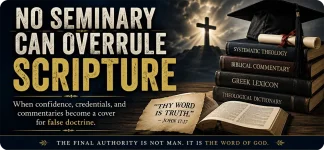
No Seminary Can Overrule Scripture

What should be the final authority when testing doctrine?

  • Scripture alone, no matter who disagrees

  • Scripture plus trusted teachers and commentaries

  • Church tradition and historical interpretation

  • A person’s education, training, or credentials

  • Whatever interpretation seems most reasonable to me


Results are only viewable after voting.

David

Know the Bible
Admin
Joined
May 13, 2025
Messages
1,270
Reaction score
1,679
Points
113
Age
67
Location
Charlestown, IN
Website
know-the-bible.com
Gender
Male
Country
United States
This poll is meant to make one thing clear: Bible knowledge, teachers, and study tools may be useful, but they must never sit above the written Word of God.

no_seminary_can_overrule_scripture_rounded_corners2.webp

When confidence, credentials, and commentaries become a cover for false doctrine

A man can know the language, quote the teachers, name the schools, carry the credentials, and still be wrong if his doctrine contradicts the plain words of Christ. Bible knowledge is a gift when it bows before God. But when it becomes a shield for pride, it turns dangerous fast. Scripture never tells us to test doctrine by a diploma. It tells us to test everything by the Word of God.

That is where many people get tripped up. They hear someone speak with confidence, use academic terms, mention Greek or Hebrew, cite well-known teachers, or talk about years of study, and suddenly they feel like the issue must be settled. But Scripture does not say, “Believe every educated man.” It says, “Beloved, believe not every spirit, but try the spirits whether they are of God” ~1 John 4:1.

The test is not how educated a man is. The test is whether what he teaches agrees with Scripture.

The Lord Jesus dealt with men who knew the Scriptures outwardly but missed the truth standing right in front of them. He said, “Search the scriptures; for in them ye think ye have eternal life: and they are they which testify of me. And ye will not come to me, that ye might have life” ~John 5:39-40. That is one of the most sobering warnings in the Bible. These men searched the Scriptures, but they refused the Christ to whom the Scriptures pointed.

So yes, a person can study the Bible and still miss the truth. A person can know doctrine, quote passages, and argue theology, yet still resist what God has plainly said.

The scribes and Pharisees are a clear example. They were not ignorant men. They were religiously trained, respected, and confident. Yet Jesus said to them, “Ye do err, not knowing the scriptures, nor the power of God” ~Matthew 22:29. Think about that. These were men who handled Scripture constantly, yet Jesus said they did not truly know the Scriptures.

That should sober every teacher, preacher, forum member, and Bible student.

Paul was highly educated in the religion of his people. He said he was “brought up in this city at the feet of Gamaliel, and taught according to the perfect manner of the law of the fathers” ~Acts 22:3. But before Christ saved him, all that learning did not make him right with God. He was zealous, but wrong. He was confident, but blind. He was religious, but persecuting the church of God.

Later Paul looked back and said, “But what things were gain to me, those I counted loss for Christ” ~Philippians 3:7. His credentials did not save him. His religious training did not justify him. His zeal did not excuse him. Everything had to bow before Christ.

That is the point. Education may be useful, but it is never final. Scripture is final.

The Bereans give us the right example. When Paul preached, they did not accept the message merely because Paul was educated, gifted, or apostolic. Scripture says they “received the word with all readiness of mind, and searched the scriptures daily, whether those things were so” ~Acts 17:11. That is the biblical pattern. Receive the Word seriously, then test the teaching by Scripture.

Not by personality. Not by confidence. Not by degrees. Not by commentaries. Not by how many professors agree. By Scripture.

This matters because false doctrine often does not come dressed like open rebellion. Sometimes it comes dressed in polished language, academic confidence, and claims of superior interpretation. A person may say, “I use the literal method,” but if his conclusion contradicts the plain words of Jesus, then his method has failed. A person may say, “Many teachers confirmed this,” but if Scripture denies it, then those teachers are wrong too.

No group of men can vote false doctrine into truth.

This is especially serious when the gospel is involved. Jesus said, “I am the way, the truth, and the life: no man cometh unto the Father, but by me” ~John 14:6. Peter said, “Neither is there salvation in any other” ~Acts 4:12. John wrote, “He that hath the Son hath life; and he that hath not the Son of God hath not life” ~1 John 5:12. Paul wrote, “For there is one God, and one mediator between God and men, the man Christ Jesus” ~1 Timothy 2:5.

Those verses are not unclear. They do not leave room for a Christ-bypassing path to God. They do not teach that moral sincerity, general belief in God, natural revelation, or non-Christian religion can save a man apart from faith in Jesus Christ. If someone teaches otherwise, he is not offering a deeper interpretation. He is contradicting the gospel.

That is not a minor issue. That is not just a difference of opinion. That is not something to shrug off because a person has education. Paul said, “Though we, or an angel from heaven, preach any other gospel unto you than that which we have preached unto you, let him be accursed” ~Galatians 1:8. If even an angel would be rejected for preaching another gospel, then no seminary credential can protect a man who does the same.

The same danger appears when people make spiritual growth sound mainly powered by human effort. Yes, believers must study. Yes, believers must obey. Yes, believers must grow, repent, learn, and be diligent. Scripture says, “Study to shew thyself approved unto God” ~2 Timothy 2:15. But the believer’s growth is not a human-powered project with God contributing a little and man contributing the rest.

Jesus said, “without me ye can do nothing” ~John 15:5. Paul said, “For it is God which worketh in you both to will and to do of his good pleasure” ~Philippians 2:13. He also wrote, “Not that we are sufficient of ourselves to think any thing as of ourselves; but our sufficiency is of God” ~2 Corinthians 3:5.

That is the balance of Scripture. We are responsible to obey, but God is the One who works in us. We are commanded to grow, but grace is not replaced by self-powered religion. We are to search the Scriptures, but commentaries and teachers never become the final authority.

The danger is not education itself. The danger is pride wearing education like armor.

A humble man with an open Bible is in a safer place than a proud man with a wall full of diplomas. The humble man can be corrected. The proud man keeps explaining why he cannot be wrong.

Scripture warns us plainly: “Knowledge puffeth up, but charity edifieth” ~1 Corinthians 8:1. Knowledge without humility can make a man dangerous. It can make him sharp with words but dull toward truth. It can make him quick to correct others but slow to examine himself. It can make him sound confident while leading people away from what God has said.

We should welcome Bible discussion. We should welcome questions. We should welcome serious study. We should welcome people searching the Scriptures carefully. But we do not bow to credentials, commentaries, or confidence when they conflict with the Word of God.

The question is not, “Where did this man study?” The question is, “What does Scripture say?”

The question is not, “How confident does he sound?” The question is, “Does his doctrine agree with Christ?”

The question is not, “How many teachers back him up?” The question is, “Can this teaching stand before the whole counsel of God?”

No seminary can overrule Scripture. No professor can correct Christ. No commentary can rewrite the gospel. No man’s confidence can turn false doctrine into truth.

Let God be true, and every man a liar. ~Romans 3:4
 
Hello David;

After reading No Seminary Can Overrule Scripture I found it very constructive, truthful and I would like to share my thoughts.

I attended Golden Gate Baptist Theological Seminary for 15 years. I earned a 5 year diploma in Christian Leadership, another 5 year diploma in Theology and a 5 year Masters in Theological Studies. I trained to serve in the pastoral ministry.

This is not a humble brag. It was very challenging. At times I wanted to drop out. I lacked confidence in comprehending. I didn't want to open my text and study, flunked a class on Christian Ethics which led into a heated argument with my professor because he gave me the failing grade! Most of all, I took away the Lord's glory because I originally asked Him to give me favor when I was admitted to seminary only later I wanted to quit.

Many of my fellow seminarians earned their Masters of Divinity or phD which trains them to become a professor, publish theological research or serve in a specialized Church leadership role in an association.

Many others
trained to become long term missionaries in some of the most undesirable places on earth where God sends them to serve for many years.

Here's what I observed and learned in my experience. Many ministers use clever "catch phrases," "talking points" and "cliches" to get their Christian message across. I cringe at this and pray for the Lord to give me a patient and listening ear.

I studied Hebrew and Greek but never made a point to reference them in a paper, sermon or general conversation with other believers. It's my opinion that the Hebrew and Greek is critical for deep theological study and work. It's original texts cannot easily be translated into modern English.

But my attitude has always been, aside from those original languages, is that the English language with it's multiple definitions can serve the disciple well in studying the Bible. I never turned in a paper, thesis or final in Hebrew or Greek but in English and did well with my professors.

The seminary I attended never taught the seminarian basic accounting and costing. I feel this study is important in ministry. Many pastors in these times can't budget their own personal checking account.

The seminary taught studies on "preaching" but didn't help develop people skills which I brought up in a class discussion because we are in fact in the people business.

Still, seminary has it's benefits. It prepares for continual self study, growth and equipping the minister for future directions wherever the Lord may send His servant.

Many pastors who didn't go to seminary are indeed anointed and called to shepherd the sheep and have done a good work in bringing others to Christ, evangelizing, teaching and preaching.

The downside of many pastors who didn't attend even a few classes of seminary weren't trained, however felt led, (but were not called by God) must remain studious because in time they can become "limited" in their teaching and preaching.

The list can go on and on but what minimizes these points bring us to the truth that Scripture, the infallible Word of God is what trumps all areas of seminary, expensive workshops / conferences and it's objectives.

So when I speak to any young believer who is considering attending seminary I will mention all objectives to help them pray in making a formal decision to serve God.

God bless you, David.

Bob
 
Last edited:
The seminary taught studies on "preaching" but didn't help develop people skills which I brought up in a class discussion because we are in fact in the people business.
I agree with the heart of what you're saying. Some seminaries can be useful when they stay under Scripture. But the moment one teaches a man to stand over the Bible, question it, correct it, or explain away the plain words of God, it has stopped training servants and started producing something dangerous. That is not education. That is pride with a vocabulary.

A man can know Greek, quote Hebrew, stack books to the ceiling, and still be dead wrong if he does not tremble at God's Word. The Pharisees had religious training and public respect, but Jesus told them plainly, “Ye do err, not knowing the scriptures, nor the power of God” ~Matthew 22:29. The disciples were unlearned and ignorant men by the rulers' standards, yet Acts 4:13 says the leaders “took knowledge of them, that they had been with Jesus.” That is the difference. The issue is not whether a man has sat in a classroom. The issue is whether he has been with Christ and bows to His Word.

Seminary, language study, books, and teachers can be good servants. But they make terrible masters. When those tools climb onto the throne where Scripture belongs, the Word gets pushed aside and man takes its place. Paul told Timothy, “Study to shew thyself approved unto God” ~2 Timothy 2:15, but he also charged him, “Preach the word” ~2 Timothy 4:2. The goal is not to sound educated. The goal is to rightly handle and faithfully proclaim what God has said.

Not everyone gets to go to seminary because of life circumstances, and going may not be God's plan for everyone. God can use a trained man, and God can use an ordinary man with an open Bible, a clean conscience, and a surrendered heart. But He does not use prideful men who handle His Word carelessly and then hide behind credentials. James warns, “My brethren, be not many masters, knowing that we shall receive the greater condemnation” ~James 3:1. Teaching is not a stage for ego. It is a place of accountability before God.

Some seminaries have taught false doctrine and spiritually damaged men who entered wanting to preach the good news of Jesus Christ. They came out questioning the Word, weakening the gospel, or trusting human wisdom more than Scripture. Paul warned about this: “Beware lest any man spoil you through philosophy and vain deceit, after the tradition of men, after the rudiments of the world, and not after Christ” ~Colossians 2:8. He also spoke of those who have “a form of godliness, but denying the power thereof” ~2 Timothy 3:5.

I want to be clear. I am not against men going to seminary. Good training can be helpful when it stays submitted to Scripture.

But the older I get, the more I see much of the visible church turning the wrong way. That tells me something is broken somewhere. If the men being trained for ministry are coming out weaker on Scripture, softer on sin, confused on the gospel, or more loyal to man’s ideas than God’s Word, then the problem is serious.

Some seminaries are no longer strengthening men to preach the truth of the Bible. They are corrupting men who once wanted to preach the good news of Jesus Christ. I have heard the stories. Men go in wanting to proclaim the Word, and come out questioning the Word, explaining away the Word, or replacing it with human wisdom.

That is not biblical preparation for ministry. That is spiritual damage.

And the danger does not stop with the man. When that man gets behind a pulpit, the church follows his teaching. If the shepherd is drifting, the sheep are going to be led the wrong way too. Jesus said, “Can the blind lead the blind? shall they not both fall into the ditch?” ~Luke 6:39.

That is why Scripture matters more than credentials. A degree cannot make false doctrine true. A seminary cannot overrule God. A pastor is not faithful because he sounds educated. He is faithful when he preaches the truth of the Word.

Paul told Timothy, “Preach the word; be instant in season, out of season; reprove, rebuke, exhort with all longsuffering and doctrine” ~2 Timothy 4:2. Then he warned that people would not endure sound doctrine, but would gather teachers who tell them what they want to hear ~2 Timothy 4:3.

That is exactly what we are seeing. The answer is not less Bible and more human wisdom. The answer is getting back under the authority of Scripture.

Seminary may help a man, but only if it teaches him to bow before the Word of God. If it teaches him to stand over the Bible, it is not helping him. It is preparing him to lead others into error.

God bless you, Bob. Your comments added a lot to the discussion.
 
Hello David;

After reading No Seminary Can Overrule Scripture I found it very constructive, truthful and I would like to share my thoughts.

I attended Golden Gate Baptist Theological Seminary for 15 years. I earned a 5 year diploma in Christian Leadership, another 5 year diploma in Theology and a 5 year Masters in Theological Studies. I trained to serve in the pastoral ministry.

This is not a humble brag. It was very challenging. At times I wanted to drop out. I lacked confidence in comprehending. I didn't want to open my text and study, flunked a class on Christian Ethics which led into a heated argument with my professor because he gave me the failing grade! Most of all, I took away the Lord's glory because I originally asked Him to give me favor when I was admitted to seminary only later I wanted to quit.

Many of my fellow seminarians earned their Masters of Divinity or phD which trains them to become a professor, publish theological research or serve in a specialized Church leadership role in an association.

Many others
trained to become long term missionaries in some of the most undesirable places on earth where God sends them to serve for many years.

Here's what I observed and learned in my experience. Many ministers use clever "catch phrases," "talking points" and "cliches" to get their Christian message across. I cringe at this and pray for the Lord to give me a patient and a listening ear.

I studied Hebrew and Greek but never made a point to reference them in a paper, sermon or general conversation with other believers. It's my opinion that the Hebrew and Greek is critical for deep theological study and work. It's original texts cannot easily be translated into modern English.

But my attitude has always been, aside from those original languages, is that the English language with it's multiple definitions can serve the disciple well in studying the Bible. I never turned in a paper, thesis or final in Hebrew or Greek but in English and did well with my professors.

The seminary I attended never taught the seminarian basic accounting and costing. I feel this study is important in ministry. Many pastors in these times can't budget their own personal checking account.

The seminary taught studies on "preaching" but didn't help develop people skills which I brought up in a class discussion because we are in fact in the people business.

Still, seminary has it's benefits. It prepares for continual self study, growth and equipping the minister for future directions wherever the Lord may send His servant.

Many pastors who didn't go to seminary are indeed anointed and called to shepherd the sheep and have done a good work in bringing others to Christ, evangelizing, teaching and preaching.

The downside of many pastors who didn't attend even a few classes of seminary weren't trained and limited in their studies, however felt led, (but were not called by God) must remain studious because in time they can become "limited" in their teaching and preaching.

The list can go on and on but what minimizes these points bring us to the truth that Scripture, the infallible Word of God is what trumps all areas of seminary, expensive workshops / conferences and it's objectives.

So when I speak to any young believer who is considering attending seminary I will mention all objectives to help them pray in making a formal decision in serving God.

God bless you, David.

Bob
Hi Bob and David,
It is so encouraging and enlightening to hear of your histories, backgrounds and testimonies : )
I am wondering whether these "testimonies" could be attached to your profiles, so that anyone wanting to know more about you, could look you up under your profile?

Just a thought : )
 
Many ministers use clever "catch phrases," "talking points" and "cliches" to get their Christian message across. I cringe at this and pray for the Lord to give me a patient and listening ear.
could you shed more light on this ?


"
Still, seminary has it's benefits. It prepares for continual self study, growth and equipping the minister for future directions wherever the Lord may send His servant.

Many pastors who didn't go to seminary are indeed anointed and called to shepherd the sheep and have done a good work in bringing others to Christ, evangelizing, teaching and preaching.

The downside of many pastors who didn't attend even a few classes of seminary weren't trained, however felt led, (but were not called by God) must remain studious because in time they can become "limited" in their teaching and preaching.

The list can go on and on but what minimizes these points bring us to the truth that Scripture, the infallible Word of God is what trumps all areas of seminary, expensive workshops / conferences and it's objectives.

So when I speak to any young believer who is considering attending seminary I will mention all objectives to help them pray in making a formal decision to serve God.
there is nothing wrong with seminary provided it doesnt make you a educated preacher... i recently attended couple nights service the evangelist held a dr degree . the message had meaning behind it.. but the presentation was bit dry.. Bob lives in calif i live in the ozarks of mo .most of the pastors preachers are graduates from the Holy Ghost school of hard knocks. in other words they had read and study and let God develop them..

most of us are bi vocational preachers.. just some time back we visited another church rev, the evangelist was all business..42 years in the ministry he stepped on toes including mine.


i would have loved to do some schooling in ministry .. many times i have go back to the potters wheel. i enjoy men like jay Vernon McGee in fact i have his app on my phone and i listen to him every day. i even have his commentaries . a common sense preacher with a degree ..i enjoy Charles Stanley bit different in his preaching and i enjoy Adrien Rogers all mean with DR degrees but brings it down to a level of understanding..


intoday society you want a big church get a doc degree and you have it.. i see advertisements for pastors must have the degree.. but is He called of God .

some preachers cant preach with out a note book.. some preach from the cuff . education is good used the right way.. but in the end its the anointing that destroys the yoke. Bob has a tender heart always looking for the good no matter what..... me well i am a work in progress been that way about 27 years .. yes he is still working on me.. just call me peter a tad bit sporadic in nature,, when the preacher gets there we have preaching
 
Hello by grace;

Thank you for sharing and also for your past testimonies. What stood out with me was the baptisms you've done.

Hazel and I visited St. Louis about 4 years ago, a part of the USA we visited together for the first time. We officiated a wedding and before we left Missouri we visited the Gateway Arch, the highest man built arch in the world.

1779485097295.webp

God bless you, by grace.

Bob
 
Here's what I observed and learned in my experience. Many ministers use clever "catch phrases," "talking points" and "cliches" to get their Christian message across. I cringe at this and pray for the Lord to give me a patient and listening ear.
could you shed more light on this ?

Hello by grace;

Yes. When a seasoned preacher or Christian speaker use phrases or expressions like, "let go and let God," or "God works in mysterious ways," or "when God closes a door He opens another," or "everything happens for a reason," etc...

I have a problem with this. I feel it's a polite way of being dismissive during a sermon or presentation to those who are suffering. But I do get it. The preacher or speaker who have longed used these phrases want to "engage and encourage" the congregation or audience but I feel they could use more "substance sprinkled with authentic compassion." This would help get the verb of the message across.

My problem with this is on me. It's the way I receive it from listening to seminarians and long time seasoned preachers and speakers.

Until God teaches me otherwise, I pray for patience and sustenance of a listening ear. This way I don't refute the speaker in error and expose my folly.

God bless you, by grace.

Bob
 
what preachers and Christians often for get is 1 Lord 1 Faith 1 baptism that works in and through all. i have a 2 year old man attending our church feels he is called to preach .i am trying to help him.. he has a battle his gparents who he lives with are apostolic but will not attend Church. yet because he is not in this type Church they tend give him flack over it.. all fairview is trying to do is be the Church God wants us to be not a denominational name


Hello by grace;

Yes. When a seasoned preacher or Christian speaker use phrases or expressions like, "let go and let God," or "God works in mysterious ways," or "when God closes a door He opens another," or "everything happens for a reason," etc...

I have a problem with this. I feel it's a polite way of being dismissive during a sermon or presentation to those who are suffering. But I do get it. The preacher or speaker who have longed used these phrases want to "engage and encourage" the congregation or audience but I feel they could use more "substance sprinkled with authentic compassion." This would help get the verb of the message across.

My problem with this is on me. It's the way I receive it from listening to seminarians and long time seasoned preachers and speakers.

Until God teaches me otherwise, I pray for patience and sustenance of a listening ear. This way I don't refute the speaker in error and expose my folly.

God bless you, by grace.


everyone has quirks you have yours i have mine.. not sure i used these phrases.. i usually am upfront honest .. tell the congregation everyone of us need help. i understand what your saying.. see i come up under old school preaching . sometimes some of the off the wall phrases are used to make a point..


a old time preacher man i use to know.. i considered him father in the lord.. he had his faults but knew the word.. he use to say preaching is lie eating Chicken eat the meat throw the bones away. our worlds are different as where we live.. IN Christ there is no difference we have this thing we all battle called personalities .

yes there are some preachers that just dont turn my crank !!! i enjoy Charles Stanley ..but i will not listen to Andy his son..

your education has defined you and that is a good thing.
 
Yes. When a seasoned preacher or Christian speaker use phrases or expressions like, "let go and let God," or "God works in mysterious ways," or "when God closes a door He opens another," or "everything happens for a reason," etc...

I have a problem with this. I feel it's a polite way of being dismissive during a sermon or presentation to those who are suffering. But I do get it. The preacher or speaker who have longed used these phrases want to "engage and encourage" the congregation or audience but I feel they could use more "substance sprinkled with authentic compassion." This would help get the verb of the message across.
I so agree with the take on these phrases ... I find them repetative, dismissive and meaningless.
On this forum, the people are "real" ... honest, humble, patient, caring and loving ... this makes the "substance" on BTF come alive in Christ!
Thank You, everyone for your lovely sharing xxx
 
Hello by grace;

Thank you for sharing and also for your past testimonies. What stood out with me was the baptisms you've done.

Hazel and I visited St. Louis about 4 years ago, a part of the USA we visited together for the first time. We officiated a wedding and before we left Missouri we visited the Gateway Arch, the highest man built arch in the world.

View attachment 431

God bless you, by grace.

Bob
My wife, son, and I were just there yesterday. We were there for 2 days.

StLouis2.webp
 
This poll is meant to make one thing clear: Bible knowledge, teachers, and study tools may be useful, but they must never sit above the written Word of God.


View attachment 426

When confidence, credentials, and commentaries become a cover for false doctrine

A man can know the language, quote the teachers, name the schools, carry the credentials, and still be wrong if his doctrine contradicts the plain words of Christ. Bible knowledge is a gift when it bows before God. But when it becomes a shield for pride, it turns dangerous fast. Scripture never tells us to test doctrine by a diploma. It tells us to test everything by the Word of God.

That is where many people get tripped up. They hear someone speak with confidence, use academic terms, mention Greek or Hebrew, cite well-known teachers, or talk about years of study, and suddenly they feel like the issue must be settled. But Scripture does not say, “Believe every educated man.” It says, “Beloved, believe not every spirit, but try the spirits whether they are of God” ~1 John 4:1.

The test is not how educated a man is. The test is whether what he teaches agrees with Scripture.

The Lord Jesus dealt with men who knew the Scriptures outwardly but missed the truth standing right in front of them. He said, “Search the scriptures; for in them ye think ye have eternal life: and they are they which testify of me. And ye will not come to me, that ye might have life” ~John 5:39-40. That is one of the most sobering warnings in the Bible. These men searched the Scriptures, but they refused the Christ to whom the Scriptures pointed.

So yes, a person can study the Bible and still miss the truth. A person can know doctrine, quote passages, and argue theology, yet still resist what God has plainly said.

The scribes and Pharisees are a clear example. They were not ignorant men. They were religiously trained, respected, and confident. Yet Jesus said to them, “Ye do err, not knowing the scriptures, nor the power of God” ~Matthew 22:29. Think about that. These were men who handled Scripture constantly, yet Jesus said they did not truly know the Scriptures.

That should sober every teacher, preacher, forum member, and Bible student.

Paul was highly educated in the religion of his people. He said he was “brought up in this city at the feet of Gamaliel, and taught according to the perfect manner of the law of the fathers” ~Acts 22:3. But before Christ saved him, all that learning did not make him right with God. He was zealous, but wrong. He was confident, but blind. He was religious, but persecuting the church of God.

Later Paul looked back and said, “But what things were gain to me, those I counted loss for Christ” ~Philippians 3:7. His credentials did not save him. His religious training did not justify him. His zeal did not excuse him. Everything had to bow before Christ.

That is the point. Education may be useful, but it is never final. Scripture is final.

The Bereans give us the right example. When Paul preached, they did not accept the message merely because Paul was educated, gifted, or apostolic. Scripture says they “received the word with all readiness of mind, and searched the scriptures daily, whether those things were so” ~Acts 17:11. That is the biblical pattern. Receive the Word seriously, then test the teaching by Scripture.

Not by personality. Not by confidence. Not by degrees. Not by commentaries. Not by how many professors agree. By Scripture.

This matters because false doctrine often does not come dressed like open rebellion. Sometimes it comes dressed in polished language, academic confidence, and claims of superior interpretation. A person may say, “I use the literal method,” but if his conclusion contradicts the plain words of Jesus, then his method has failed. A person may say, “Many teachers confirmed this,” but if Scripture denies it, then those teachers are wrong too.

No group of men can vote false doctrine into truth.

This is especially serious when the gospel is involved. Jesus said, “I am the way, the truth, and the life: no man cometh unto the Father, but by me” ~John 14:6. Peter said, “Neither is there salvation in any other” ~Acts 4:12. John wrote, “He that hath the Son hath life; and he that hath not the Son of God hath not life” ~1 John 5:12. Paul wrote, “For there is one God, and one mediator between God and men, the man Christ Jesus” ~1 Timothy 2:5.

Those verses are not unclear. They do not leave room for a Christ-bypassing path to God. They do not teach that moral sincerity, general belief in God, natural revelation, or non-Christian religion can save a man apart from faith in Jesus Christ. If someone teaches otherwise, he is not offering a deeper interpretation. He is contradicting the gospel.

That is not a minor issue. That is not just a difference of opinion. That is not something to shrug off because a person has education. Paul said, “Though we, or an angel from heaven, preach any other gospel unto you than that which we have preached unto you, let him be accursed” ~Galatians 1:8. If even an angel would be rejected for preaching another gospel, then no seminary credential can protect a man who does the same.

The same danger appears when people make spiritual growth sound mainly powered by human effort. Yes, believers must study. Yes, believers must obey. Yes, believers must grow, repent, learn, and be diligent. Scripture says, “Study to shew thyself approved unto God” ~2 Timothy 2:15. But the believer’s growth is not a human-powered project with God contributing a little and man contributing the rest.

Jesus said, “without me ye can do nothing” ~John 15:5. Paul said, “For it is God which worketh in you both to will and to do of his good pleasure” ~Philippians 2:13. He also wrote, “Not that we are sufficient of ourselves to think any thing as of ourselves; but our sufficiency is of God” ~2 Corinthians 3:5.

That is the balance of Scripture. We are responsible to obey, but God is the One who works in us. We are commanded to grow, but grace is not replaced by self-powered religion. We are to search the Scriptures, but commentaries and teachers never become the final authority.

The danger is not education itself. The danger is pride wearing education like armor.

A humble man with an open Bible is in a safer place than a proud man with a wall full of diplomas. The humble man can be corrected. The proud man keeps explaining why he cannot be wrong.

Scripture warns us plainly: “Knowledge puffeth up, but charity edifieth” ~1 Corinthians 8:1. Knowledge without humility can make a man dangerous. It can make him sharp with words but dull toward truth. It can make him quick to correct others but slow to examine himself. It can make him sound confident while leading people away from what God has said.

We should welcome Bible discussion. We should welcome questions. We should welcome serious study. We should welcome people searching the Scriptures carefully. But we do not bow to credentials, commentaries, or confidence when they conflict with the Word of God.

The question is not, “Where did this man study?” The question is, “What does Scripture say?”

The question is not, “How confident does he sound?” The question is, “Does his doctrine agree with Christ?”

The question is not, “How many teachers back him up?” The question is, “Can this teaching stand before the whole counsel of God?”

No seminary can overrule Scripture. No professor can correct Christ. No commentary can rewrite the gospel. No man’s confidence can turn false doctrine into truth.

Let God be true, and every man a liar. ~Romans 3:4

Many modern misunderstandings of the Bible are because of poor and sometimes deliberately wrong translation. Like English, both Hebrew and Greek have many words with multiple meanings. The Greek word translated as "doctrine" for example, in Greek simply means teaching.

One example is the Greek word "kosmos", which has three different meanings in the Bible, while the KJV and many other translations render this only as "world", which is misleading and not the likely intention. "Love not the world" actually means love not the "world system". In John 3:16, "world" actually refers to people, in Greek "sea of humanity", as in "for God so loved the people, that he have the only begotten son. . ."

Kosmos also can mean world or earth. It all depends on context, how this should be translated. For example, when one verse says God so loved the world and another says, love not the world, this becomes a confusing translation to many and, should be corrected as noted above.
 
Many modern misunderstandings of the Bible are because of poor and sometimes deliberately wrong translation. Like English, both Hebrew and Greek have many words with multiple meanings. The Greek word translated as "doctrine" for example, in Greek simply means teaching.

One example is the Greek word "kosmos", which has three different meanings in the Bible, while the KJV and many other translations render this only as "world", which is misleading and not the likely intention. "Love not the world" actually means love not the "world system". In John 3:16, "world" actually refers to people, in Greek "sea of humanity", as in "for God so loved the people, that he have the only begotten son. . ."

Kosmos also can mean world or earth. It all depends on context, how this should be translated. For example, when one verse says God so loved the world and another says, love not the world, this becomes a confusing translation to many and, should be corrected as noted above.
The fact that a Greek word can have different senses in different contexts does not prove that the English translation is poor or deliberately wrong. That is normal language. The English word “world” also has several meanings, and readers determine the intended meaning from the sentence and context.

Yes, the Greek word translated “doctrine” means teaching. That does not weaken the biblical meaning. Doctrine is teaching, especially teaching that is to be believed and obeyed. Paul commanded Timothy, “Take heed unto thyself, and unto the doctrine” ~1 Timothy 4:16. Calling it “teaching” does not make doctrine less important.

Your explanation of kosmos also goes beyond what the Greek word itself means. Kosmos does not literally mean “sea of humanity.” In ~John 3:16, it refers to the world of fallen humanity that God loved and to which He sent His Son. In ~1 John 2:15, John explains what he means by the world that must not be loved: “the lust of the flesh, and the lust of the eyes, and the pride of life” ~1 John 2:16. The context already makes the distinction clear.

There is no contradiction between God loving the world and commanding believers not to love the world. God loved sinful people and sent His Son to save them. Believers are forbidden to love the sinful desires, values, and rebellion that characterize the world opposed to God.

A translator should not replace the inspired word with an interpretation every time it appears. That can hide the connections the biblical writer intended. The answer is not to accuse translations of misleading people, but to read each verse in its context and allow Scripture to explain Scripture.
 
The fact that a Greek word can have different senses in different contexts does not prove that the English translation is poor or deliberately wrong. That is normal language. The English word “world” also has several meanings, and readers determine the intended meaning from the sentence and context.

Yes, the Greek word translated “doctrine” means teaching. That does not weaken the biblical meaning. Doctrine is teaching, especially teaching that is to be believed and obeyed. Paul commanded Timothy, “Take heed unto thyself, and unto the doctrine” ~1 Timothy 4:16. Calling it “teaching” does not make doctrine less important.

Your explanation of kosmos also goes beyond what the Greek word itself means. Kosmos does not literally mean “sea of humanity.” In ~John 3:16, it refers to the world of fallen humanity that God loved and to which He sent His Son. In ~1 John 2:15, John explains what he means by the world that must not be loved: “the lust of the flesh, and the lust of the eyes, and the pride of life” ~1 John 2:16. The context already makes the distinction clear.

There is no contradiction between God loving the world and commanding believers not to love the world. God loved sinful people and sent His Son to save them. Believers are forbidden to love the sinful desires, values, and rebellion that characterize the world opposed to God.

A translator should not replace the inspired word with an interpretation every time it appears. That can hide the connections the biblical writer intended. The answer is not to accuse translations of misleading people, but to read each verse in its context and allow Scripture to explain Scripture.
According to several Bible scholars who understand Greek, kosmos means "world or earth", "sea of humanity" and "world system".

Compare the English word off: It has at least five meanings; turn the light off, back off, he was a little off, off base, leading off. Such is the nature of human language and Hebrew and Greek are no different.

The proper context is based on what the author most likely intends; sometimes it's a matter of translator choice. But the words on this list below are deliberately mistranslated in most modern bibles to appease Christian tradition:

Gospel - correctly translated as "good news" from the Greek.

Church – “assembly”.

Apostle – “sent one”, such as Paul and Peter the “sent ones”. Paul calls other people “sent ones” besides the twelve, including a woman.

Deacon - "servant".

Bishop - "overseer” or “elder".

Pastor– "shepherd". Shepherds did not preach sermons and were not the leader.

Word (in John 1:1) – correctly translated as “logos”. Logos means creative Mind behind the universal reality; ultimate truth and wisdom; universal and beyond view or God's view, as opposed to human understanding. Logos did not mean “word” to the Greeks, as modern bibles mistranslate the entire idea and meaning.

Epistle - "letter".

Doctrine -"teaching".

Homosexual - correctly translated as “homosexual sex”, referring to the act, not the person. God is not against people. Rather, God is against what people often do, including fornication, adultery and homosexual sex; all three listed together in I Corinthians 6:9. “For God did not send his son into the world that he might judge the people, but that the people through him might be saved.”

Disciple – "follower" /"student".

Angel – “messenger”

Minister– “servant”

Ministry - “service”

Preach - "proclaim" – anyone can proclaim the good news of Jesus; no religious degree either needed, required or desired. However, one should be very careful regarding anything in the Bible, that they understand and teach others correctly.

Saint - a saint is someone who has been made holy by being washed by the blood of Jesus. No pope or other human being can make anyone a saint. Only Jesus can make someone a saint. And we cannot make ourselves a saint by doing good works or refraining from certain things. Only through forgiveness from Jesus can someone become a saint.

Jesus is deliberately secular, eating, drinking and associating with sinners and the common people, while railing against the religionists of his time. The New Testament is written in secular Koine Greek, the language of the common people. True religion is defined in James I:27.
 
Preach - "proclaim" – anyone can proclaim the good news of Jesus; no religious degree either needed, required or desired. However, one should be very careful regarding anything in the Bible, that they understand and teach others correctly.

Saint - a saint is someone who has been made holy by being washed by the blood of Jesus. No pope or other human being can make anyone a saint. Only Jesus can make someone a saint. And we cannot make ourselves a saint by doing good works or refraining from certain things. Only through forgiveness from Jesus can someone become a saint.

Jesus is deliberately secular, eating, drinking and associating with sinners and the common people, while railing against the religionists of his time. The New Testament is written in secular Koine Greek, the language of the common people. True religion is defined in James I:27.
So agree with this ... nothing has changed about "church" (the word as most commonly used, and not His "saints") ... the "church" still harbours "imposters" (fakes)

Jesus warned ...

Jesus Saves!
 
Last edited:
According to several Bible scholars who understand Greek, kosmos means "world or earth", "sea of humanity" and "world system".
Appealing to unnamed Bible scholars does not settle the matter. Scripture is the authority, not scholars. “Yea, let God be true, but every man a liar” ~Romans 3:4.

Many of the words you listed are not mistranslations at all. “Gospel” means good news, “church” means assembly, “apostle” means one sent, “pastor” means shepherd, and “doctrine” means teaching. The traditional English words still communicate those meanings. Using an English term that comes from an older linguistic form does not amount to deliberate deception.

Your explanation of logos in ~John 1:1 is the most serious problem. John does not define the Logos as a “creative Mind behind universal reality.” That language is not found in the text. John identifies the Logos personally and plainly: “In the beginning was the Word, and the Word was with God, and the Word was God” ~John 1:1. He then says, “And the Word was made flesh, and dwelt among us” ~John 1:14. The Word is not an abstract universal mind or philosophical principle. The Word is Jesus Christ, who was with God and was God.

Your statement that shepherds were not leaders also contradicts Scripture. Peter commanded elders, “Feed the flock of God which is among you, taking the oversight thereof” ~1 Peter 5:2. Paul told the Ephesian elders that the Holy Ghost had made them overseers “to feed the church of God” ~Acts 20:28. Shepherding, overseeing, feeding, teaching, and leading are joined together in the biblical office. Paul also wrote, “Let the elders that rule well be counted worthy of double honour, especially they who labour in the word and doctrine” ~1 Timothy 5:17.

You say Paul called other people “sent ones” besides the twelve, including a woman. But simply being sent with a message or assignment does not establish that someone held the governing office and authority of the apostles.

Scripture uses the word in broader ways. Epaphroditus is called “your messenger” in ~Philippians 2:25, and the Greek word is apostolos. That did not make him one of the twelve or prove that he possessed apostolic authority over the churches.

Therefore, pointing out that a woman may have been called a “sent one” does not prove that women were appointed to teach or exercise authority over men. The clear command remains: “But I suffer not a woman to teach, nor to usurp authority over the man, but to be in silence” ~1 Timothy 2:12.

Your handling of ~1 Corinthians 6:9 is also inaccurate. The verse does not list fornication, adultery, and “homosexual sex” as though one Greek expression simply meant the act without identifying those practicing it. It says, “Neither fornicators, nor idolaters, nor adulterers, nor effeminate, nor abusers of themselves with mankind.” Paul is identifying people by the sins they practice, just as he does with thieves, covetous people, drunkards, revilers, and extortioners in the next verse. God certainly loves sinners, but Scripture does not separate unrepentant sinners from the sins they choose to practice. “He that doeth wrong shall receive for the wrong which he hath done” ~Colossians 3:25.

Richard, you wrote, “For God did not send his son into the world that he might judge the people, but that the people through him might be saved.”

Where are you finding that wording in Scripture? Are you quoting a particular translation, paraphrasing a passage, or stating your own interpretation? I want to be careful to address what you actually mean.

Jesus was not “deliberately secular.” He ate with sinners to call them to repentance: “I came not to call the righteous, but sinners to repentance” ~Luke 5:32. He did not join them in their sin or present Himself as opposed to all religion. He condemned hypocrisy, false teaching, pride, and man-made tradition. He also said, “I do always those things that please him” ~John 8:29.

Words must be understood in context, but their meanings cannot be replaced with philosophical ideas, personal interpretations, or accusations of conspiracy. “Add thou not unto his words, lest he reprove thee, and thou be found a liar” ~Proverbs 30:6.
 
Jesus is deliberately secular, eating, drinking and associating with sinners and the common people, while railing against the religionists of his time. The New Testament is written in secular Koine Greek, the language of the common people. True religion is defined in James I:27.
Richard, the link to your website has been removed and may not be promoted or posted on Biblical Truth Forum.

After reviewing material on the site, I found teachings that contradict Scripture, including unsupported claims about Jesus, a serious minimizing of His doctrine and saving work, and statements about sexuality that are not grounded in the Bible.

BTF will not direct members to material that misrepresents Christ or introduces teaching contrary to God’s Word. “Prove all things; hold fast that which is good” ~1 Thessalonians 5:21.

You are welcome to continue participating in discussions here, provided you follow the forum rules and do not promote or introduce those false teachings on BTF. All doctrine presented here must be supported by Scripture and remain open to correction from Scripture.
 
So agree with this ... nothing has changed about "church" (the word as most commonly used, and not His "saints") ... the "church" still harbours "imposters" (fakes)

Jesus warned ...

Jesus Saves!
The word "church" is a Middle English term that didn't exist at the time of Jesus and the New Testament. Jesus calls his followers his "assembly" and that is the word we should use. People don't speak Middle English today and neither should the Bible be quoted in Middle English, making it confusing and difficult to understand.

Many modern people hear the word church and they think of a building or a religious organization. While on the other hand, the word "assembly" clearly refers to people assembled together, the clear intention of Jesus and the New Testament.
 
The word "church" is a Middle English term that didn't exist at the time of Jesus and the New Testament. Jesus calls his followers his "assembly" and that is the word we should use. People don't speak Middle English today and neither should the Bible be quoted in Middle English, making it confusing and difficult to understand.

Many modern people hear the word church and they think of a building or a religious organization. While on the other hand, the word "assembly" clearly refers to people assembled together, the clear intention of Jesus and the New Testament.

Good morning, Richard;

"The word "church" is a Middle English term that didn't exist at the time of Jesus and the New Testament."

To a degree this is correct but I strongly believe Jesus was referring to the assembly, ekklesia, gathering of people, thus Church which He mentions in His teaching reference Matthew 16 and 18.

Getting back to the verb of this topic, I agree that seminary cannot overrule Scripture. In my experience, seminary trained me to teach the Gospel, give the unbelievers the opportunity to know Jesus and shepherd my Church family.

Speaking for myself, seminary also taught me how to listen (a tough discipline,) avoid sub-contextual discussions and overuse Christianese talk (especially to those who were trying to grasp, understand and interpret the Bible,) walking in obedience to God but most of all, loving others and introducing Christ.

But whenever I pulled the "seminary card" it could not trump the Scriptures and most of all, what God is revealing in those people and life situations.

Richard, I can see you are defending your apologetics, the Greek, Hebrew and that's fine. Perhaps you can author a thread of this subject in another forum at Biblical Truth Forum.

God bless you, Richard, and your entire family.

Bob
 
let me summarize all this up. we all have opinions. we tend get so educated we forget the Holyghost school . a good education is worth its weight in gold , but i have listened online to men with degrees teaching.. just to be honest he Bored me

here is my thought in scripture 1 Corinthians 4:15
For though ye have ten thousand instructors in Christ, yet ye have not many fathers; for in Christ Jesus I have begotten you through the Gospel.'

Zechariah 4:6
6;Then he answered and spake unto me, saying, This is the word of the Lord unto Zerubbabel, saying, Not by might, nor by power, but by my spirit, saith the Lord of hosts.

i have known men who could barely read.. but could preach the word..
i over heard a evangelist say he has been in the word over 40 years and every time he thinkls he understands it all. he is shown different
 
Back
Top Bottom