Do "Eunuch" and "LGBT" have anything in common and how is this addressed in the Bible?

Yesua888

Well-known member
Joined
Nov 15, 2025
Messages
765
Reaction score
683
Points
93
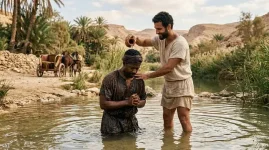
1788601300072.webp Baptising of the Ethiopian Eunuch

There is much controversy and debate on this subject, so let's explore what Scripture says:

The Bible does not explicitly mention "intersex individuals", as the concept was not understood in biblical times and the scripture primarily presents a binary view of gender as male and female.

While the Old Testament contains laws restricting certain individuals with physical abnormalities from the assembly (Deuteronomy 23:1), the New Testament narrative emphasizes that all people are created in the image of God. Genesis 1:27: "So God created mankind in his own image, in the image of God he created him; male and female he created them."

Christian scholars and theologians often interpret the biblical category of "eunuchs who were born that way" as referring to a "third gender". Matthew 19:12: "For there are some eunuchs, which were so born from their mother's womb: and there are some eunuchs, which were made eunuchs of men: and there be eunuchs, which have made themselves eunuchs for the kingdom of heaven's sake. He that is able to receive it, let him receive it."

Some Progressive scholars and commentators argue that in the ancient world, the Greek eunouchos and Hebrew saris were broad enough to include a range of gender-variant and sexual-minority persons — intersex people, effeminate men, and possibly those with same-sex attraction. The reasoning: in a world without modern categories, "eunuch" was the catch-all term for anyone who fell outside the male/female binary or who was sexually "other."

The Hebrew cultural background: Some scholars point to ancient Jewish categories for people with ambiguous sex characteristics — tumtum (a male with ambiguous genitalia), saris hamah (a "natural eunuch"), and ay'lonit hamah (a woman with atypical development). These are distinct from castrated eunuchs and map more closely to what we'd now call intersex conditions. The argument is that Jesus, speaking in a Jewish context, would have had these categories in mind when he said "born that way."

Tumtum: The term does not appear in the Scripture but is found 17 times in the Mishnah and 119 times in the Babylonian Talmud.
Saris: While the root word for "eunuch" appears in the Bible, the specific rabbinic categorization of saris hamah (natural eunuch) vs. saris adam (eunuch by human intervention) is a development of Rabbinic law.
Aylonit: This term is also exclusive to Rabbinic texts (Mishnah and Talmud) and is not found in the Biblical text.

The Hebrew Bible (Old Testament) contains no explicit verses that mention or define the tumtum or androgynos, as these are post-biblical categories developed in Rabbinic literature (Mishnah, Talmud) to address legal ambiguities not covered by the scriptural binary of "male and female" (e.g., Genesis 1:27)

What does the Bible say, is there a the "link" between "eunuch" and "LGBT"?

Galatians 3:28: "neither Jew nor Gentile, neither slave nor free, neither male nor female, for you are all one in Christ Jesus." This principle is reinforced by Colossians 3:11, which declares that in Christ, distinctions such as Gentile or Jew, circumcised or uncircumcised, barbarian, Scythian, slave, or free are irrelevant as "Christ is all, and is in all."

Matthew 19:12: Jesus simply acknowledges three categories exist. He offers no condemnation, no call for exclusion, and no moral verdict on any group. The "born that way" group is named with the same neutral tone as the other two. "...and there are eunuchs who have made themselves eunuchs for the sake of the kingdom of heaven. Let the one who is able to accept this accept it."

The phrase "for the sake of the kingdom of heaven" explicitly ties the third category to a spiritual vocation — choosing singleness to serve God — not to a statement about sexual orientation or gender identity.

While Acts 8 does not list multiple gender categories, it uses the men and women of Samaria (Acts 8:12) and the eunuch (Acts 8:27) to illustrate the breaking down of traditional gender and ethnic boundaries in the Christian community.

Matthew 19:3–9: Jesus affirms the indissolubility of marriage ("what God has joined together, let no one separate"). The topic is the sanctity of the marriage bond, not gender or orientation.

No single verse says affirms homosexual relationships. The argument is contextual, and it rests on two verses working together:

Matthew 19:10: "The disciples said to him, 'If such is the case of a man with his wife, it is better not to marry.'"

Matthew 19:11: "Not everyone can accept this word, but only those to whom it has been given." The "gift" here is the capacity for celibacy, paralleling Paul's "gift of singleness." It is about whether one can abstain from marriage, not about who one is attracted to.

Matthew 19:12: "For there are eunuchs who have been so from birth, and there are eunuchs who have been made eunuchs by men, and there are eunuchs who have made themselves eunuchs for the sake of the kingdom of heaven. Let the one who is able to receive this receive it." Refers to celibacy.

The entire pericope (19:3–12) is a teaching on divorce and the permanence of marriage, marriageability and celibacy, and not about affirming homosexual relationships. Therefore the structural parallel doesn't carry through to the conclusion the scholars want.

1 Corinthians 7:32–35: Paul's reasoning for singleness is entirely practical: the unmarried man is "concerned with the things of the Lord, how he may please the Lord." The point is focus of service, not orientation.

1 Corinthians 7:9: "But if they cannot exercise self-control, let them marry. For it is better to marry than to burn with passion." This directly undercuts any reading that treats non-marriage as an identity to be affirmed; the default remains marriage, and singleness is a dispensation for those who have the gift.

The counterargument: Other scholars (e.g., at Answers in Genesis, and some standard Greek lexicons) push back: the word eunouchoi in ancient Greek and Jewish usage was never used to denote intersex or androgynous persons. In context, Jesus is addressing marriageability — who can or cannot enter the covenant of marriage — not gender identity. The "born that way" group are simply those born without functional reproductive capacity (infertility, absence of organs), and Jesus' point is that celibacy is a valid state, not that a third gender exists.

So the interpretation hinges on whether you read the passage as describing a category of people (and, if so, which one) or as making a point about marriage and celibacy in which eunuchs are simply the illustrative example.

Same-sex sexual relations are sin: marriage is exclusively one man and one woman. This is held across the spectrum from historic dispensationalists (Charles Chafer, Charles Scofield, Charles Walvoord, Charles Ryrie) to more recent figures like John MacArthur and John F. MacArthur's successors at The Master's Seminary.
 
Agreed, this is a hot topic, and we must keep our toes planted firmly in what God said. The second we bring labels of today into the text and allow them to define Scripture, we have it backwards. Scripture must define the topic at hand.

One thing I would add at the outset is that we cannot treat Christ’s silence on a subject in one passage as approval when the rest of Scripture speaks plainly. Matthew 19 is about marriage, divorce, and celibacy. Jesus was not discussing same-sex conduct or gender identity there. So we must not use that passage to make a conclusion Scripture itself never makes.

LGBT is not a biblical category. There is no example of a eunuch being described as homosexual, transgender, intersex, or a third gender in the Bible. Scripture does not tell us about a eunuch’s sexual desires or how he lived sexually. It says that some eunuchs were unable to reproduce from birth, some were made eunuchs by men, and the word could at times be used of a royal officer. Potiphar was called an officer of Pharaoh in Genesis 39:1, using that same word. So we cannot take every occurrence and try to force a modern identity into it.

Matthew 19 settles the foundation. The Pharisees asked Jesus about divorce, and He answered, “He which made them at the beginning made them male and female,” and, “For this cause shall a man leave father and mother, and shall cleave to his wife: and they twain shall be one flesh” (Matthew 19:4-6). That is not ambiguous. God made male and female. God instituted marriage between a man and his wife.

When the disciples realized how binding marriage was, they responded, “It is not good to marry” (Matthew 19:10), and Jesus spoke of eunuchs. “There are some eunuchs, which were so born from their mother’s womb: and there are some eunuchs, which were made eunuchs of men: and there be eunuchs, which have made themselves eunuchs for the kingdom of heaven’s sake” (Matthew 19:12).

This passage is not teaching who can enter a same-sex relationship, who someone feels himself to be, or how to create another gender. If a man chooses to remain celibate for the Lord, that does not mean God rewrote His design after creation. Paul said the unmarried man “careth for the things that belong to the Lord, how he may please the Lord” (1 Corinthians 7:32-35), but that does not mean he was something other than a male. He served as an unmarried man.

Galatians 3:28 gets taken out of context when used in this manner: “There is neither Jew nor Greek, there is neither bond nor free, there is neither male nor female: for ye are all one in Christ Jesus.” The subject is salvation and inheritance in Christ. A man and a woman both believe and are equally saved by faith. The verse does not destroy creation or nullify what God said about marriage and sexual purity.

Under the Law, “a man wounded in his stones, or hath his privy member cut off, shall not enter into the congregation of the LORD” (Deuteronomy 23:1). Yet the Lord promised faithful eunuchs, “unto them will I give in mine house and within my walls a place and a name better than of sons and of daughters” (Isaiah 56:3-5). Acts 8 demonstrates the grace of God.

Philip preached Jesus to the Ethiopian eunuch from Isaiah 53:7-8, and the eunuch believed and was baptized. His physical condition, his nationality, and the former restriction under the Law did not keep him from Christ. That is what the passage actually shows. Acts 8 identifies him as “a man of Ethiopia” and “an eunuch” (Acts 8:27). It never labels him homosexual, transgender, or LGBT. We should rejoice in what it does say rather than put in what God did not say.

Tumtum and aylonit are not biblical terms. They do not appear in Moses, the Prophets, the words of Christ, or the apostles. Genesis 1:27 is crystal clear: “male and female created he them.”

God is also clear throughout Scripture on the sexual activity people now hide behind that label. “Thou shalt not lie with mankind, as with womankind: it is abomination” (Leviticus 18:22). Romans 1 says women “did change the natural use into that which is against nature,” and men, “leaving the natural use of the woman, burned in their lust one toward another” (Romans 1:26-27). “The unrighteous shall not inherit the kingdom of God,” and that list includes “effeminate” and “abusers of themselves with mankind” (1 Corinthians 6:9-10).

God is telling us the truth about sin. We do no one any favors by relabeling sin as something we are or celebrating what Christ died to save us from.

“And such were some of you: but ye are washed, but ye are sanctified, but ye are justified in the name of the Lord Jesus” (1 Corinthians 6:11). No sinner who comes to Christ in repentance and faith is beyond His saving grace.

So eunuchs and LGBT are not equivalent, nor should they be placed together as though they are. Eunuch is a biblical word for a man with a physical condition or, at times, an official. LGBT is a modern label not found in the Bible. No one is made right with God by an identity, a physical condition, or a label. We are made right with God through repentance and faith in Jesus Christ.
 
LGBT is not a biblical category. There is no example of a eunuch being described as homosexual, transgender, intersex, or a third gender in the Bible. Scripture does not tell us about a eunuch’s sexual desires or how he lived sexually. It says that some eunuchs were unable to reproduce from birth, some were made eunuchs by men, and the word could at times be used of a royal officer. Potiphar was called an officer of Pharaoh in Genesis 39:1, using that same word. So we cannot take every occurrence and try to force a modern identity into it.

Tumtum and aylonit are not biblical terms. They do not appear in Moses, the Prophets, the words of Christ, or the apostles. Genesis 1:27 is crystal clear: “male and female created he them.”

So eunuchs and LGBT are not equivalent, nor should they be placed together as though they are. Eunuch is a biblical word for a man with a physical condition or, at times, an official. LGBT is a modern label not found in the Bible. No one is made right with God by an identity, a physical condition, or a label. We are made right with God through repentance and faith in Jesus Christ.

Baptising of the Ethiopian Eunuch

There is much controversy and debate on this subject, so let's explore what Scripture says:

The Bible does not explicitly mention "intersex individuals", as the concept was not understood in biblical times and the scripture primarily presents a binary view of gender as male and female.

While the Old Testament contains laws restricting certain individuals with physical abnormalities from the assembly (Deuteronomy 23:1), the New Testament narrative emphasizes that all people are created in the image of God. Genesis 1:27: "So God created mankind in his own image, in the image of God he created him; male and female he created them."

Christian scholars and theologians often interpret the biblical category of "eunuchs who were born that way" as referring to a "third gender". Matthew 19:12: "For there are some eunuchs, which were so born from their mother's womb: and there are some eunuchs, which were made eunuchs of men: and there be eunuchs, which have made themselves eunuchs for the kingdom of heaven's sake. He that is able to receive it, let him receive it."

Some Progressive scholars and commentators argue that in the ancient world, the Greek eunouchos and Hebrew saris were broad enough to include a range of gender-variant and sexual-minority persons — intersex people, effeminate men, and possibly those with same-sex attraction. The reasoning: in a world without modern categories, "eunuch" was the catch-all term for anyone who fell outside the male/female binary or who was sexually "other."

The Hebrew cultural background: Some scholars point to ancient Jewish categories for people with ambiguous sex characteristics — tumtum (a male with ambiguous genitalia), saris hamah (a "natural eunuch"), and ay'lonit hamah (a woman with atypical development). These are distinct from castrated eunuchs and map more closely to what we'd now call intersex conditions. The argument is that Jesus, speaking in a Jewish context, would have had these categories in mind when he said "born that way."

Tumtum: The term does not appear in the Scripture but is found 17 times in the Mishnah and 119 times in the Babylonian Talmud.
Saris: While the root word for "eunuch" appears in the Bible, the specific rabbinic categorization of saris hamah (natural eunuch) vs. saris adam (eunuch by human intervention) is a development of Rabbinic law.
Aylonit: This term is also exclusive to Rabbinic texts (Mishnah and Talmud) and is not found in the Biblical text.

The Hebrew Bible (Old Testament) contains no explicit verses that mention or define the tumtum or androgynos, as these are post-biblical categories developed in Rabbinic literature (Mishnah, Talmud) to address legal ambiguities not covered by the scriptural binary of "male and female" (e.g., Genesis 1:27)

What does the Bible say, is there a the "link" between "eunuch" and "LGBT"?

Galatians 3:28: "neither Jew nor Gentile, neither slave nor free, neither male nor female, for you are all one in Christ Jesus." This principle is reinforced by Colossians 3:11, which declares that in Christ, distinctions such as Gentile or Jew, circumcised or uncircumcised, barbarian, Scythian, slave, or free are irrelevant as "Christ is all, and is in all."

Matthew 19:12: Jesus simply acknowledges three categories exist. He offers no condemnation, no call for exclusion, and no moral verdict on any group. The "born that way" group is named with the same neutral tone as the other two. "...and there are eunuchs who have made themselves eunuchs for the sake of the kingdom of heaven. Let the one who is able to accept this accept it."

The phrase "for the sake of the kingdom of heaven" explicitly ties the third category to a spiritual vocation — choosing singleness to serve God — not to a statement about sexual orientation or gender identity.

While Acts 8 does not list multiple gender categories, it uses the men and women of Samaria (Acts 8:12) and the eunuch (Acts 8:27) to illustrate the breaking down of traditional gender and ethnic boundaries in the Christian community.

Matthew 19:3–9: Jesus affirms the indissolubility of marriage ("what God has joined together, let no one separate"). The topic is the sanctity of the marriage bond, not gender or orientation.

No single verse says affirms homosexual relationships. The argument is contextual, and it rests on two verses working together:

Matthew 19:10: "The disciples said to him, 'If such is the case of a man with his wife, it is better not to marry.'"

Matthew 19:11: "Not everyone can accept this word, but only those to whom it has been given." The "gift" here is the capacity for celibacy, paralleling Paul's "gift of singleness." It is about whether one can abstain from marriage, not about who one is attracted to.

Matthew 19:12: "For there are eunuchs who have been so from birth, and there are eunuchs who have been made eunuchs by men, and there are eunuchs who have made themselves eunuchs for the sake of the kingdom of heaven. Let the one who is able to receive this receive it." Refers to celibacy.

The entire pericope (19:3–12) is a teaching on divorce and the permanence of marriage, marriageability and celibacy, and not about affirming homosexual relationships. Therefore the structural parallel doesn't carry through to the conclusion the scholars want.

1 Corinthians 7:32–35: Paul's reasoning for singleness is entirely practical: the unmarried man is "concerned with the things of the Lord, how he may please the Lord." The point is focus of service, not orientation.

1 Corinthians 7:9: "But if they cannot exercise self-control, let them marry. For it is better to marry than to burn with passion." This directly undercuts any reading that treats non-marriage as an identity to be affirmed; the default remains marriage, and singleness is a dispensation for those who have the gift.

The counterargument: Other scholars (e.g., at Answers in Genesis, and some standard Greek lexicons) push back: the word eunouchoi in ancient Greek and Jewish usage was never used to denote intersex or androgynous persons. In context, Jesus is addressing marriageability — who can or cannot enter the covenant of marriage — not gender identity. The "born that way" group are simply those born without functional reproductive capacity (infertility, absence of organs), and Jesus' point is that celibacy is a valid state, not that a third gender exists.

So the interpretation hinges on whether you read the passage as describing a category of people (and, if so, which one) or as making a point about marriage and celibacy in which eunuchs are simply the illustrative example.

Same-sex sexual relations are sin: marriage is exclusively one man and one woman. This is held across the spectrum from historic dispensationalists (Charles Chafer, Charles Scofield, Charles Walvoord, Charles Ryrie) to more recent figures like John MacArthur and John F. MacArthur's successors at The Master's Seminary.

Hello Yesua888 and David;

BTF has increased in good topics and this is refreshing.

Yesua888, I have never given thought regarding eunuchs suggesting LGBT or intersex individuals. It's not Biblical so it just never crossed my mind in my personal study of the Bible. I feel the Scriptures in your OP support that.

David shared about the Hebrew and Greek. I love my Jewish and Greek brother and sister disciples, but I'm not entertained by their words and phrases that are often quoted or cross referenced to the Bible. Why? I've always been challenged just reading God's Word in English and I'm very happy with that. The English Bible has taught me the application and errors of my daily walk with Jesus. Most of the time I will dig deeper with my English study (which also has multiple definition) that will align with Biblical Scriptures.

These are the two areas that jumped at me and wanted to share my thoughts. Thank you for sharing this topic.

God bless you, Yesua888.

Bob
 
God is also clear throughout Scripture on the sexual activity people now hide behind that label. “Thou shalt not lie with mankind, as with womankind: it is abomination” (Leviticus 18:22). Romans 1 says women “did change the natural use into that which is against nature,” and men, “leaving the natural use of the woman, burned in their lust one toward another” (Romans 1:26-27). “The unrighteous shall not inherit the kingdom of God,” and that list includes “effeminate” and “abusers of themselves with mankind” (1 Corinthians 6:9-10).

“And such were some of you: but ye are washed, but ye are sanctified, but ye are justified in the name of the Lord Jesus” (1 Corinthians 6:11). No sinner who comes to Christ in repentance and faith is beyond His saving grace.


So eunuchs and LGBT are not equivalent, nor should they be placed together as though they are. Eunuch is a biblical word for a man with a physical condition or, at times, an official. LGBT is a modern label not found in the Bible. No one is made right with God by an identity, a physical condition, or a label. We are made right with God through repentance and faith in Jesus Christ.
 
Hello Yesua888 and David;

BTF has increased in good topics and this is refreshing.

Yesua888, I have never given thought regarding eunuchs suggesting LGBT or intersex individuals. It's not Biblical so it just never crossed my mind in my personal study of the Bible. I feel the Scriptures in your OP support that.

David shared about the Hebrew and Greek. I love my Jewish and Greek brother and sister disciples, but I'm not entertained by their words and phrases that are often quoted or cross referenced to the Bible. Why? I've always been challenged just reading God's Word in English and I'm very happy with that. The English Bible has taught me the application and errors of my daily walk with Jesus. Most of the time I will dig deeper with my English study (which also has multiple definition) that will align with Biblical Scriptures.

These are the two areas that jumped at me and wanted to share my thoughts. Thank you for sharing this topic.

God bless you, Yesua888.

Bob
Hi Bob,

This sure is a good topic, and I thank you and David for your input : )

This "topic" was created because I came across a "Christian" website that was addressing "Parents with LGBT Children" ...

The "likeness" of LGBT to Eunuchs was addressed, and an example was given of Christ's "compassion" when He addressed the gathering around an adulteress who was about to be stoned. There were some compelling scriptural quotes, being used to "strengthen" the author's (a priest) narrative. I realised that these verses were taken out of context, and needed to know more ...

My search began to find anything in the Bible that addressed a "third sex"

Thanks to David for putting it all together so well, as the Conclusion of:

Do "Eunuch" and "LGBT" have anything in common and how is this addressed in the Bible?​

In BTF David successfully brings us back to Scripture, every time!

🙏 🙏 🙏
 
Back
Top Bottom