


Yesua888
Well-known member
- Joined
- Nov 15, 2025
- Messages
- 765
- Reaction score
- 683
- Points
- 93
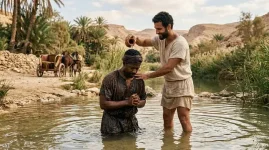 Baptising of the Ethiopian Eunuch
There is much controversy and debate on this subject, so let's explore what Scripture says:
The Bible does not explicitly mention "intersex individuals", as the concept was not understood in biblical times and the scripture primarily presents a binary view of gender as male and female.
While the Old Testament contains laws restricting certain individuals with physical abnormalities from the assembly (Deuteronomy 23:1), the New Testament narrative emphasizes that all people are created in the image of God. Genesis 1:27: "So God created mankind in his own image, in the image of God he created him; male and female he created them."
Christian scholars and theologians often interpret the biblical category of "eunuchs who were born that way" as referring to a "third gender". Matthew 19:12: "For there are some eunuchs, which were so born from their mother's womb: and there are some eunuchs, which were made eunuchs of men: and there be eunuchs, which have made themselves eunuchs for the kingdom of heaven's sake. He that is able to receive it, let him receive it."
Some Progressive scholars and commentators argue that in the ancient world, the Greek eunouchos and Hebrew saris were broad enough to include a range of gender-variant and sexual-minority persons — intersex people, effeminate men, and possibly those with same-sex attraction. The reasoning: in a world without modern categories, "eunuch" was the catch-all term for anyone who fell outside the male/female binary or who was sexually "other."
The Hebrew cultural background: Some scholars point to ancient Jewish categories for people with ambiguous sex characteristics — tumtum (a male with ambiguous genitalia), saris hamah (a "natural eunuch"), and ay'lonit hamah (a woman with atypical development). These are distinct from castrated eunuchs and map more closely to what we'd now call intersex conditions. The argument is that Jesus, speaking in a Jewish context, would have had these categories in mind when he said "born that way."
Tumtum: The term does not appear in the Scripture but is found 17 times in the Mishnah and 119 times in the Babylonian Talmud.
Saris: While the root word for "eunuch" appears in the Bible, the specific rabbinic categorization of saris hamah (natural eunuch) vs. saris adam (eunuch by human intervention) is a development of Rabbinic law.
Aylonit: This term is also exclusive to Rabbinic texts (Mishnah and Talmud) and is not found in the Biblical text.
The Hebrew Bible (Old Testament) contains no explicit verses that mention or define the tumtum or androgynos, as these are post-biblical categories developed in Rabbinic literature (Mishnah, Talmud) to address legal ambiguities not covered by the scriptural binary of "male and female" (e.g., Genesis 1:27)
What does the Bible say, is there a the "link" between "eunuch" and "LGBT"?
Galatians 3:28: "neither Jew nor Gentile, neither slave nor free, neither male nor female, for you are all one in Christ Jesus." This principle is reinforced by Colossians 3:11, which declares that in Christ, distinctions such as Gentile or Jew, circumcised or uncircumcised, barbarian, Scythian, slave, or free are irrelevant as "Christ is all, and is in all."
Matthew 19:12: Jesus simply acknowledges three categories exist. He offers no condemnation, no call for exclusion, and no moral verdict on any group. The "born that way" group is named with the same neutral tone as the other two. "...and there are eunuchs who have made themselves eunuchs for the sake of the kingdom of heaven. Let the one who is able to accept this accept it."
The phrase "for the sake of the kingdom of heaven" explicitly ties the third category to a spiritual vocation — choosing singleness to serve God — not to a statement about sexual orientation or gender identity.
While Acts 8 does not list multiple gender categories, it uses the men and women of Samaria (Acts 8:12) and the eunuch (Acts 8:27) to illustrate the breaking down of traditional gender and ethnic boundaries in the Christian community.
Matthew 19:3–9: Jesus affirms the indissolubility of marriage ("what God has joined together, let no one separate"). The topic is the sanctity of the marriage bond, not gender or orientation.
No single verse says affirms homosexual relationships. The argument is contextual, and it rests on two verses working together:
Matthew 19:10: "The disciples said to him, 'If such is the case of a man with his wife, it is better not to marry.'"
Matthew 19:11: "Not everyone can accept this word, but only those to whom it has been given." The "gift" here is the capacity for celibacy, paralleling Paul's "gift of singleness." It is about whether one can abstain from marriage, not about who one is attracted to.
Matthew 19:12: "For there are eunuchs who have been so from birth, and there are eunuchs who have been made eunuchs by men, and there are eunuchs who have made themselves eunuchs for the sake of the kingdom of heaven. Let the one who is able to receive this receive it." Refers to celibacy.
The entire pericope (19:3–12) is a teaching on divorce and the permanence of marriage, marriageability and celibacy, and not about affirming homosexual relationships. Therefore the structural parallel doesn't carry through to the conclusion the scholars want.
1 Corinthians 7:32–35: Paul's reasoning for singleness is entirely practical: the unmarried man is "concerned with the things of the Lord, how he may please the Lord." The point is focus of service, not orientation.
1 Corinthians 7:9: "But if they cannot exercise self-control, let them marry. For it is better to marry than to burn with passion." This directly undercuts any reading that treats non-marriage as an identity to be affirmed; the default remains marriage, and singleness is a dispensation for those who have the gift.
The counterargument: Other scholars (e.g., at Answers in Genesis, and some standard Greek lexicons) push back: the word eunouchoi in ancient Greek and Jewish usage was never used to denote intersex or androgynous persons. In context, Jesus is addressing marriageability — who can or cannot enter the covenant of marriage — not gender identity. The "born that way" group are simply those born without functional reproductive capacity (infertility, absence of organs), and Jesus' point is that celibacy is a valid state, not that a third gender exists.
So the interpretation hinges on whether you read the passage as describing a category of people (and, if so, which one) or as making a point about marriage and celibacy in which eunuchs are simply the illustrative example.
Same-sex sexual relations are sin: marriage is exclusively one man and one woman. This is held across the spectrum from historic dispensationalists (Charles Chafer, Charles Scofield, Charles Walvoord, Charles Ryrie) to more recent figures like John MacArthur and John F. MacArthur's successors at The Master's Seminary.

