- Joined
- May 13, 2025
- Messages
- 1,270
- Reaction score
- 1,679
- Points
- 113
- Age
- 67
- Location
- Charlestown, IN
- Website
- know-the-bible.com
- Gender
- Male
- Country
- United States
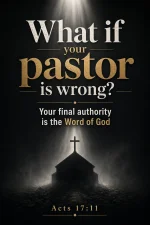
That is not a comfortable question, but it is a necessary one. A lot of people act like asking it is automatically rebellious, proud, or divisive. It is not. In fact, refusing to ask it can be far more dangerous. If a man is teaching the Word of God, then what he says should stand up to the Word of God. If it does not, then the problem is not with the person who tests the teaching. The problem is with the teaching. Pastors matter. Faithful shepherds are a gift from God. Scripture tells us that Christ gave pastors and teachers for the building up of His people (Ephesians 4:11-12). A godly pastor should be respected, heard carefully, and treated with honor. But none of that means he becomes our final authority. Scripture never gives that place to a pastor. It gives that place to the Word of God.
Acts 17:11 says, “These were more noble than those in Thessalonica, in that they received the word with all readiness of mind, and searched the scriptures daily, whether those things were so.” That verse should settle a lot of things for us. The Bereans were not checking a false teacher. They were checking Paul. They heard his preaching, received it eagerly, and then searched the Scriptures to see whether it was true. The Holy Spirit calls that noble, not disrespectful. That means testing preaching by Scripture is not a sign of spiritual arrogance. It is a sign of spiritual seriousness.
Think about it this way. If a doctor tells you something serious about your health, you do not prove your humility by refusing to check it. If a contractor tells you the foundation of your house is sound, you do not prove your respect by ignoring visible cracks in the walls. In both cases, the issue is too important to just nod along and hope for the best. Truth matters. Accuracy matters. The condition of your soul matters even more.
And yet many Christians will carefully compare prices before buying a refrigerator, read reviews before hiring a mechanic, and double-check a bank statement over a minor charge, but will sit under teaching week after week without ever asking, “Where does the Bible actually say that?” That is backwards.
A pastor can be sincere and still be wrong. He can be educated and still be wrong. He can have good intentions and still be wrong. He can have a large church, a polished presentation, and a long ministry record and still be wrong. None of those things make a man infallible. Only Scripture is God-breathed. “All scripture is given by inspiration of God” (2 Timothy 3:16). Not sermons. Not church traditions. Not denominational statements. Scripture.
This is one of the great problems in our time. Many people say they believe the Bible, but in practice they believe whatever they have always heard at church. If you challenge the teaching, they do not open the Scriptures. They appeal to the pastor. They say, “My pastor says…” as if that ends the discussion. But the real question is not what your pastor says. The real question is what God says. That is why 1 Thessalonians 5:21 says, “Prove all things; hold fast that which is good.” Scripture does not tell us to swallow everything whole. It tells us to test. It tells us to examine. It tells us to hold fast to what is good only after it has been proven.
Paul goes even farther in Galatians 1:8: “But though we, or an angel from heaven, preach any other gospel unto you than that which we have preached unto you, let him be accursed.” Notice how strong that is. Paul does not ask for loyalty to personalities. He demands loyalty to the true gospel. He even puts himself under that same standard. If the message departs from the truth already given by God, it is to be rejected no matter who brings it.
That destroys the mindset that says, “I know what the Bible says, but my pastor explains it differently, so I will just go with him.” No. If the teaching does not agree with Scripture, Scripture wins. Every time.
Some people hear that and immediately worry that it will lead to pride, independence, and everybody becoming their own authority. That danger is real, but it does not cancel the biblical command to test all things. The answer to blind trust in pastors is not arrogant self-trust. The answer is humble submission to Scripture. A believer is not called to exalt his own opinions over a pastor’s opinions. He is called to bring both under the authority of God’s Word. That is an important difference.
There is also a deeper heart issue here. Sometimes people do not want to test what they are hearing because they are afraid of what they might find. If they discover their pastor has been wrong about something important, then they may have to admit they were wrong too. They may have to change their views. They may have to leave a comfortable tradition behind. That can be costly. But truth is still worth it.
The Pharisees are a warning to all of us on this point. Jesus said, “In vain they do worship me, teaching for doctrines the commandments of men” (Matthew 15:9). Their problem was not that they were too concerned with religious things. Their problem was that they elevated human teaching above the Word of God. That same danger is still with us. It just wears modern clothes.
A faithful pastor should not be threatened by this. He should welcome it. If a man truly wants to preach the truth, then he should want his teaching examined by the truth. A pastor who gets angry because people search the Scriptures is acting more like a controller than a shepherd. The goal of biblical ministry is not to produce dependence on the pastor. It is to produce obedience to Christ through His Word.
So what should a Christian do? Listen carefully. Open your Bible. Read the context. Compare Scripture with Scripture. Do not just ask whether a sermon sounded powerful. Ask whether it was true. Do not ask whether it matched your tradition. Ask whether it matched the text. If your pastor teaches what the Bible teaches, receive it with joy. If he teaches something that does not stand up to Scripture, then reject the error and cling to the Word of God. That is not being contentious. That is being faithful.
At the end of the day, every pastor is just a man. Some are sound. Some are careless. Some are blind guides. Some mix truth with error. But the Word of God remains pure. Psalm 12:6 says, “The words of the Lord are pure words: as silver tried in a furnace of earth, purified seven times.” If you want something you can trust completely, trust that.
We do need to ask the question: What if your pastor is wrong?
The better question after that is this: Are you willing to follow Scripture even if it means admitting he is?
That is where the real test begins.
What do you think? Have you ever found that something you were taught in church was not actually supported by Scripture? How should a Christian handle that?