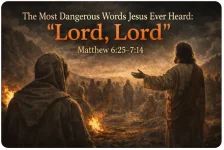
The Most Dangerous Words Jesus Ever Heard: “Lord, Lord”

David

Know the Bible
Admin
Joined
May 13, 2025
Messages
1,270
Reaction score
1,679
Points
113
Age
67
Location
Charlestown, IN
Website
know-the-bible.com
Gender
Male
Country
United States
lord-lord.webp
Most people think faith means agreeing with God while still running their own life. Jesus says that kind of faith is not faith at all.

Matthew 6:25–7:14 is not written to pagans. It is spoken to religious people. People who pray, give, worry, judge, and speak God’s name freely. Jesus does not reassure them. He exposes them.

Worry is not treated as a personality trait. Jesus calls it unbelief. “O ye of little faith” ~Matthew 6:30. A divided heart cannot serve God and mammon ~Matthew 6:24. Hypocrisy blinds a man to his own sin while he critiques others ~Matthew 7:3–5. Fruit proves reality, not profession ~Matthew 7:17.

Then Jesus says the words many refuse to hear. “Not every one that saith unto me, Lord, Lord, shall enter into the kingdom of heaven” ~Matthew 7:21. Those words are not spoken to atheists. They are spoken to people who assumed they were safe.

Jesus ends with two gates. One is wide and crowded. One is narrow and costly. Few find it ~Matthew 7:13–14. Truth is not decided by numbers.

This blog post walks straight through the passage and lets Scripture expose false assurance, religious self trust, and obedience free faith. No tradition. No softening. Just the text doing what it was written to do.

If you have ever called Jesus Lord, this passage demands honesty.

👉 Read the full post on KTB:
The Most Dangerous Words Jesus Ever Heard: “Lord, Lord”
Know the Bible

Discussion welcome.
 
View attachment 253
Most people think faith means agreeing with God while still running their own life. Jesus says that kind of faith is not faith at all.

Matthew 6:25–7:14 is not written to pagans. It is spoken to religious people. People who pray, give, worry, judge, and speak God’s name freely. Jesus does not reassure them. He exposes them.

Worry is not treated as a personality trait. Jesus calls it unbelief. “O ye of little faith” ~Matthew 6:30. A divided heart cannot serve God and mammon ~Matthew 6:24. Hypocrisy blinds a man to his own sin while he critiques others ~Matthew 7:3–5. Fruit proves reality, not profession ~Matthew 7:17.

Then Jesus says the words many refuse to hear. “Not every one that saith unto me, Lord, Lord, shall enter into the kingdom of heaven” ~Matthew 7:21. Those words are not spoken to atheists. They are spoken to people who assumed they were safe.

Jesus ends with two gates. One is wide and crowded. One is narrow and costly. Few find it ~Matthew 7:13–14. Truth is not decided by numbers.

This blog post walks straight through the passage and lets Scripture expose false assurance, religious self trust, and obedience free faith. No tradition. No softening. Just the text doing what it was written to do.

If you have ever called Jesus Lord, this passage demands honesty.

👉 Read the full post on KTB:
The Most Dangerous Words Jesus Ever Heard: “Lord, Lord”
Know the Bible

Discussion welcome.
Great, now how do we exegete this passage? How narrow is narrow? Same word is used of multitudes "tronging/ hemmed in/crushed/obstacles" Jesus Christ.

J.
 
View attachment 253
Most people think faith means agreeing with God while still running their own life. Jesus says that kind of faith is not faith at all.

Matthew 6:25–7:14 is not written to pagans. It is spoken to religious people. People who pray, give, worry, judge, and speak God’s name freely. Jesus does not reassure them. He exposes them.

Worry is not treated as a personality trait. Jesus calls it unbelief. “O ye of little faith” ~Matthew 6:30. A divided heart cannot serve God and mammon ~Matthew 6:24. Hypocrisy blinds a man to his own sin while he critiques others ~Matthew 7:3–5. Fruit proves reality, not profession ~Matthew 7:17.

Then Jesus says the words many refuse to hear. “Not every one that saith unto me, Lord, Lord, shall enter into the kingdom of heaven” ~Matthew 7:21. Those words are not spoken to atheists. They are spoken to people who assumed they were safe.

Jesus ends with two gates. One is wide and crowded. One is narrow and costly. Few find it ~Matthew 7:13–14. Truth is not decided by numbers.

This blog post walks straight through the passage and lets Scripture expose false assurance, religious self trust, and obedience free faith. No tradition. No softening. Just the text doing what it was written to do.

If you have ever called Jesus Lord, this passage demands honesty.

👉 Read the full post on KTB:
The Most Dangerous Words Jesus Ever Heard: “Lord, Lord”
Know the Bible

Discussion welcome.

Good morning, David;

Well said. I want to share my thoughts.

In Matthew 6:25-7:14 when I get hit with worry, I immediately surrender whatever is making me anxious to the Lord. I may not articulate what I want to say at that moment, but the Lord already knows and is ready to help me overcome the worry which can lead to doubt.

In Matthew 7:13-14, I have used the illustration of the wide and narrow gates;

The "ones who take advantage" of the wide and narrow gates by obtaining "instant gratification (lukewarm attitude)" of what you can obtain in the wide gate what you can't obtain in the narrow gate leads to destruction. I personally believe that.

Whereas the one who chooses the narrow gate walks in sacrifice, faces the challenges and remains in obedience (Sermon on the Mount,) etc...finds eternal life.

I love the Book of Matthew. Though the synoptic Gospels, Matthew, Mark and Luke are distinct from the Book of John, Christ offers unique teachings from each Book.

God bless you, David and your entire family.

Bob
 
Great, now how do we exegete this passage? How narrow is narrow? Same word is used of multitudes "tronging/ hemmed in/crushed/obstacles" Jesus Christ.

Johann, it is clear the moment we stop negotiating with the text.

Jesus does not ask us to measure the narrow way. He defines it by contrast and consequence. “Strait is the gate, and narrow is the way, which leadeth unto life, and few there be that find it” ~Matthew 7:14. Few is not a metaphor. It is a warning.

You can point out that similar Greek terms are used elsewhere for crowds pressing in. That observation does nothing here because context rules meaning. This passage is not describing physical pressure around Jesus. It is describing access to life versus destruction. Jesus Himself sets the boundaries.

Read the verses He places around it. He condemns divided loyalty ~Matthew 6:24. He exposes hypocritical judgment ~Matthew 7:3–5. He warns about false prophets who look right but produce bad fruit ~Matthew 7:15–20. He declares that many who say “Lord, Lord” will be rejected because they did not do the will of the Father ~Matthew 7:21–23. Then He closes with obedience versus hearing only ~Matthew 7:24–27. That is the narrow way. It is not hidden. It is costly.

The narrowness is this. You do not bring your résumé. You do not bring your crowd. You do not bring your religious activity. You come stripped. You repent. You submit. You obey. “If any man will come after me, let him deny himself, and take up his cross, and follow me” ~Matthew 16:24.

The broad way is crowded because it allows self rule. It allows calling Jesus Lord while keeping control. It allows religious language without repentance. Scripture says plainly, “There is a way which seemeth right unto a man, but the end thereof are the ways of death” ~Proverbs 14:12.

Jesus is not unclear. He is uncompromising. The problem is not exegesis. The problem is resistance. The narrow way offends pride, and pride always looks for room to breathe.

“Examine yourselves, whether ye be in the faith; prove your own selves” ~2 Corinthians 13:5. That command exists because many assume they are safe and are not.

The gate is narrow enough to exclude every version of faith that refuses obedience. That is exactly as narrow as Jesus said it is.
 
Back
Top Bottom