


- Joined
- May 13, 2025
- Messages
- 1,351
- Reaction score
- 1,863
- Points
- 113
- Age
- 67
- Location
- Charlestown, IN
- Website
- know-the-bible.com
- Gender
- Male
- Country
- United States
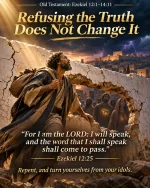
Old Testament Reading: Ezekiel 12:1–14:11
What happens when God tells people the truth, but they would rather believe a lie?
Imagine discovering a large crack running through the foundation of your house. You call someone to inspect it, and he tells you the foundation is failing. If you don't address the problem, the house could eventually collapse.
But you don't like what you're hearing. So you find someone else who tells you everything is fine. He covers the crack with fresh plaster, paints over it, and assures you there is nothing to worry about.
Now the house looks beautiful again. The crack is gone from sight. You feel relieved.
But here's the problem. The foundation is still failing.
Covering up the truth didn't change the condition of the house. It only made you feel better about something that was still terribly wrong.
That's exactly the kind of deception God was exposing through Ezekiel.
In Ezekiel 12, God describes His people as having eyes to see and ears to hear, yet they refused to see or listen. Why?
"For they are a rebellious house." (Ezekiel 12:2)
The problem wasn't that God had failed to make Himself clear. The problem was that the people didn't want to accept what He was saying.
God commanded Ezekiel to pack his belongings, dig through a wall, and act out what was coming upon Jerusalem. Ezekiel obeyed. His actions were a visible warning that captivity and judgment were approaching.
But instead of repenting, the people found ways to dismiss God's warning. Some claimed the visions would never come true. Others suggested they concerned events so far in the future that they didn't need to worry.
God answered them:
"For I am the LORD: I will speak, and the word that I shall speak shall come to pass." (Ezekiel 12:25)
Think about that. God wasn't asking them whether they agreed with His Word. He was telling them that what He had spoken would happen.
Then in Ezekiel 13, we find something even more troubling.
There were prophets telling people exactly what they wanted to hear. They claimed to speak for God, but their messages came from their own hearts.
They promised peace when there was no peace.
God compared their deception to someone building a wall and covering it with untempered mortar. It might look secure on the outside, but when the storm came, it would fall.
And notice what God said these false prophets were doing:
"Ye have strengthened the hands of the wicked, that he should not return from his wicked way, by promising him life." (Ezekiel 13:22)
Let that sink in.
These prophets weren't simply giving people incorrect information. They were actually encouraging the wicked to remain in their sin by assuring them that everything was fine.
Does that sound familiar?
How often do we hear people being reassured that they can continue living in sin without any need to repent? How often is God's warning about sin replaced with a message that makes people comfortable?
The Bible doesn't teach that God's grace gives us permission to continue in sin.
Paul asked, "Shall we continue in sin, that grace may abound?"
His answer was unmistakable:
"God forbid. How shall we, that are dead to sin, live any longer therein?" (Romans 6:1–2)
A message that encourages people to remain in sin is not made biblical simply because someone attaches God's name to it.
Then Ezekiel 14 brings the warning even closer to home.
Some of Israel's elders came to Ezekiel seeking a word from the Lord. Outwardly, they appeared interested in hearing what God had to say.
But God saw something nobody else could see.
They had set up idols in their hearts.
They wanted to inquire of God while holding on to the very things that separated them from Him.
And God's answer was not to make them feel comfortable.
"Repent, and turn yourselves from your idols; and turn away your faces from all your abominations." (Ezekiel 14:6)
Here's something we all need to consider.
It's possible to open a Bible, listen to preaching, participate in discussions about Scripture, and still resist what God is plainly telling us.
We can even look for someone who will explain away a passage because we don't like what it says.
But finding someone who agrees with us doesn't make us right.
God's Word doesn't become less true because we refuse to believe it. And sin doesn't become acceptable because someone tells us it is.
Jesus asked a question in Luke 6:46 that every one of us ought to take seriously:
"And why call ye me, Lord, Lord, and do not the things which I say?"
The people in Ezekiel's day had plenty of warnings. What they lacked was a willingness to receive them and turn from their wickedness.
We should learn from their example rather than repeat it.
God's Word is not given merely to make us feel better about ourselves. It teaches us the truth, exposes our sin, corrects us, and points us to the Lord Jesus Christ.
The question is not whether we can find someone who will tell us what we want to hear.
The question is whether we're willing to obey what God has already said.
And that leaves us with something worth examining in our own hearts:
When Scripture confronts something in our lives that needs to change, do we repent and obey God, or do we look for someone who will tell us we don't have to?


