Yesua888
Well-known member
- Joined
- Nov 15, 2025
- Messages
- 765
- Reaction score
- 683
- Points
- 93
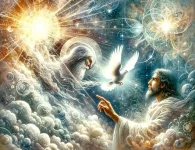
Is the "Godhead" a Mystery?
I awoke one morning with the word "Godhead" in my mind ... I wanted to clear up some of my own murkiness around the "Trinity" (this term is not found in the Bible)
The fundamental difference is that Trinitarianism teaches God is one being in three distinct, co-eternal Persons (Father, Son, and Holy Spirit) who exist simultaneously and interact with one another, whereas Modalism teaches that God is one single Person who manifests in three different modes or roles sequentially or situationally, never existing as more than one mode at a time.
Historically, Modalism (also known as Sabellianism or Oneness theology) has been condemned as heretical by mainstream Christian councils for denying the distinct personhood within the Godhead, while Trinitarianism is the orthodox doctrine affirming both the unity of God's essence and the distinction of His persons.
The strongest single refutation of Modalism is Matthew 3:16–17 combined with John 14:26: in one scene the Son is baptized, the Spirit descends onto him, and the Father speaks about him — three persons acting in distinct roles at the same moment. In John 14:26, the Father, Son, and Spirit are each doing a different thing (sending, being sent from, receiving) that a single person in "modes" could not coherently perform. (Scroll down for more Scriptural revelations)
Many battle to understand the "mystery" of the Godhead ... these are some of the questions and analogies that came up when delving into the "Trinity"
Is Holy Spirit the spirit of The Father or the spirit of Jesus, or both?
If Holy Spirit is the spirit of Father and of Jesus, then wouldn't there be 4 in the Godhead?
The Holy Spirit is one person, which can described from two angles. Think of it this way: a child can be called "my son" (from the father's perspective) and "my son" (from the mother's perspective). That doesn't make two children. It's one child, related to two different people.
All Three Present at Once
Matthew 3:16–17: At Jesus' baptism: the Son is in the water, the Spirit descends as a dove, and the Father speaks from heaven — three distinct persons acting simultaneously
Matthew 28:19: "Baptizing them in the name (singular) of the Father and of the Son and of the Holy Spirit" — one divine essence, three persons
2 Corinthians 13:14: "The grace of the Lord Jesus Christ, and the love of God, and the fellowship of the Holy Spirit" — all three named together in one benediction
Isaiah 48:16: "And now the Sovereign LORD has sent me with his Spirit" — the Son speaking, referencing both the Father and the Spirit as distinct
Some have asked about the use of the word God: When is it referring to The Father and when to the Trinity?
That could be for another "study" : )
The Father and Son Are Distinct
Matthew 26:39: Jesus prays, "My Father, if it is possible, let this cup pass from me; yet not as I will, but as you will" — two distinct wills
John 1:1: The Word was with God (πρὸς τὸν θεόν), and the Word was God" — the Son is both God and with God
John 14:28: "The Father is greater than I" — a relational distinction
John 17:1–5: The High Priestly Prayer: the Son prays to the Father, asking the Father to glorify him
Romans 8:34: Christ is "at the right hand of God" and intercedes — a distinct location and role
1 Corinthians 15:24–28: The Son will "hand over the kingdom to God the Father" — the Son is subordinate in role to the Father
The Holy Spirit Is a Distinct Person
John 14:26: "The Helper…whom I will send to you from the Father" — the Son sends the Spirit from the Father; all three are distinct agents
John 15:26: "The Spirit of truth, who proceeds from the Father, he will testify about me" — the Spirit bears witness about the Son, so cannot be the same person
Acts 5:3–4: Peter says Ananias lied "not to men but to God" — immediately after saying he lied "to the Holy Spirit." The Spirit is personally identified as God
1 John 5:6–7: "The Spirit, the water, and the blood…these three agree in one" — the Spirit is a distinct witness alongside the Father and Son.
Mutual Love Between the Persons
John 3:35: "The Father loves the Son and has given everything into his hand."
John 14:31: " love the Father" — the Son loves the Father
John 17:24–26: "The Father loved you … that the love with which he loved me may be in you" — love presupposes two distinct persons.
Only two of the "Persons" are described above - what about Holy Spirit?
The Bible never explicitly states that the Father loves the Holy Spirit or that Jesus loves the Holy Spirit. This is a well-known absence that theologians have noted.
The closest passages are:
- Luke 10:21 — Jesus "rejoiced in the Holy Spirit," which implies a positive relational dynamic but doesn't use the word "love."
- Romans 15:30 — "I appeal to you, brothers, by our Lord Jesus Christ and by the love of the Spirit" — though this is debated; many read it as "the love that exists in the Spirit" (i.e., our love for one another inspired by the Spirit) rather than the Spirit's own love for someone.
The mutual love among the three persons is inferred from the unity and fellowship language (2 Corinthians 13:14; Philippians 2:1) and from Trinitarian theology.