Yesua888
Well-known member
- Joined
- Nov 15, 2025
- Messages
- 765
- Reaction score
- 683
- Points
- 93

Christ redeemed us from the curse of the Law by being cursed for our sake since scripture says: Anyone hanged is accursed,
so that the blessing of Abraham might come to the gentiles in Christ Jesus, and so that we might receive the promised Spirit through faith.
Galatians 3:13-14
He is the sacrifice to expiate our sins, and not only ours, but also those of the whole world.
1 John 2:2
During Jesus’ life, many recognized and accepted Jesus as the prophesied Messiah (or Christ), Son of God, and anointed King of Israel. Others questioned Jesus’ authority or rejected him as the Messiah altogether. When used, the title of “King of the Jews” would have had both political and prophetic implications for both Jews and non-Jews living in Israel at the time.
Jesus - The True King of Israel
Prior to the birth of Jesus, the people of Israel had experienced a tumultuous relationship with God as a result of their disobedience and sin. God had made them His chosen people (Exodus 7:6) and “treasured possession” (Deuteronomy 7:6), going all the way back to the covenant made with Abraham (Genesis 17:6-7) and Jacob, renamed Israel Genesis 32:28, and He had established Himself as their rightful king and sovereign ruler Genesis 28:13. However, in the days of the prophet Samuel, the Jews rejected God as their God and demanded that Samuel provide for them an earthly king, similar to the kings who ruled over the surrounding nations (1 Samuel 8:5, 19).1 Samuel 3:20, his acceptance was universal and undeniable: "And all Israel from Dan to Beersheba knew that Samuel was established as a prophet of the LORD."
God nonetheless gave the people what they wanted, a temporary line of human kings, who would rule over them until Israel’s captivity in Babylon. Some of these kings served the Lord faithfully and were upright, virtuous leaders, Most, however, were selfish, corrupt, and spiritually bankrupt rulers who plunged Israel into an era of sin and idol worship.
1 Samuel 8:7 - 1 Samuel 8:22 - 1 Samuel 12:12-13: God had already provided Saul as their king.
After Saul had disobeyed the Lord and been rejected by God as king (1 Samuel 15), God anointed David (1 Samuel 16) and promised that out of David’s line, a new, anointed king would come to redeem Israel and establish his rightful place on the throne of Israel (2 Samuel 7:12-16; Isaiah 11:1-5). This, of course, was the prophesied Messiah, who the gospels confirm was Jesus, a descendent of David (Matthew 1:1, John 7:42).
Not to be discouraged or dissuaded by Israel’s rejection, God’s plan would introduce a new covenant that would see God’s love and forgiveness extend to all the world, not just the Jews John 3:16 For God so loved the world that He gave His one and only Son, that everyone who believes in Him shall not perish but have eternal life.
For generations, the Jews anticipated the arrival of their Messiah and the coming king (Micah 5:2; Isaiah 9:6-7; Psalms 22:27-31). Unfortunately, they were so accustomed to the leadership of earthly kings, they envisioned a Messiah who’d come as a political ruler, revolutionary, or royal lord, not a lowly, humble servant and son of a carpenter (Zechariah 9:9; Isaiah 53:4; Matthew 20:28; Mark 10:45; Matthew 21:1-7). They also didn’t anticipate that God’s kingdom would be a spiritual, heavenly realm.
The Anointed One Born King of the Jews
Shortly after Jesus’ birth, magi from the east arrived in Jerusalem seeking the Messiah, asking King Herod, “Where is He who has been born King of the Jews? For we saw His star in the east and have come to worship Him” (Matthew 2:2). It’s likely that the magi also thought of the Jewish Messiah as a future political ruler, which may account for why they presented Jesus’ parents with offerings of gold, frankincense, and myrrh, expensive gifts indicative of kingly worship (Matthew 2:11).Having heard the magi refer to the child as the “King of the Jews,” King Herod, a regional ruler of Judea given authority by the Romans, assembled his chief priests and scribes, who affirmed the connection to Old Testament prophesies of the Messiah (Matthew 2:4-6). This is why Herod reacted so quickly to seek out the child and destroy him, fearing any potential threat to his political power (Matthew 2:7-23).
Many in Israel, namely the Pharisees and religious leaders, rejected Jesus as the promised Messiah and “cornerstone” (Psalms 118:22 "The stone the builders rejected has become the cornerstone.") or mocked him as “king” during his crucifixion
Psalm 118:22 states: "The stone the builders rejected has become the cornerstone." This verse serves as a pivotal declaration of rejection followed by exaltation, highlighting God’s power to turn apparent failure into foundational success.
Mark 15:32 records the mocking of Jesus by the chief priests, scribes, and those crucified with Him, who taunted Him to come down from the cross as proof that He is the Christ, the King of Israel, so they might see and believe. The passage highlights their sarcastic challenge that while Jesus saved others, He cannot save Himself.
Luke 23:29 records Jesus' prophetic lament to the women of Jerusalem, stating that days are coming when people will say, "Blessed are the barren," referencing the coming judgment on Jerusalem. Mark 15:32 focuses on the immediate mockery during the crucifixion, Luke 23:29 is part of Jesus' address on the way to the cross, warning of future desolation rather than challenging His identity.
John 1:11 states that Jesus came to His own people, the Israelites (or His own creation), but they did not receive Him. This verse highlights the tragic rejection of the Messiah by the very people He came to save, marking a pivotal moment where the rejection by His own opened the way for salvation to extend to all who believe.
While the primary reference is to the Jewish people who failed to recognize Jesus as their long-awaited Messiah, the verse also carries a broader theological meaning regarding humanity's general tendency to reject God's grace. This rejection was not a failure of God's plan, but rather the mechanism that allowed eternal life to be offered to anyone who receives Him, as detailed in the subsequent verse, John 1:12 states that Jesus gives the right (or power/authority) to become children of God to all who receive Him and believe in His name. This verse serves as a critical pivot in the Gospel of John, contrasting with the preceding verses (10–11) where the world and His own people rejected Him, by highlighting that salvation is available to all who accept Him, regardless of background.
The verses extensively quoted in the New Testament to describe Jesus’ role:
- Jesus quotes it in Matthew 21:42, Mark 12:10, and Luke 20:17 to warn religious leaders of their impending judgment.
- Peter applies it to Jesus in Acts 4:11, identifying Christ as the stone rejected by the builders but central to salvation.
- Paul references it in Ephesians 2:20 to describe the Church built on the foundation of apostles and prophets with Christ as the chief cornerstone.
- Peter also writes about Christ as the "living stone" in 1 Peter 2:4–7.
A Rejected King
Jesus affirmed His identity.During Jesus’ trial, Pontius Pilate, the Roman governor, asked Jesus if he was truly the “King of the Jews” (Mark 15:2). Jesus responded, “It is as you say.” Later, Jesus confirmed that his kingdom was not an earthly, political kingdom but a spiritual kingdom and his throne was not of this earth (John 18:36).
Pilate gave permission for Jesus to be scourged and beaten, and there the Roman soldiers clothed him a purple robe, spit on him, and mocked him, shouting, “Hail! king of the Jews!” This was also when they fashioned a crown of thorns and placed it on Jesus’ head (John 19:2-3).
When Pilate brought Jesus before the Pharisees and people once more, presenting the beaten, bruised, and humiliated man as their king (John 19:14), the Jews again rejected Jesus as king and shouted for Pilate to take him away and have him crucified. Pilate asked, “Shall I crucify your king?” To this, the Jews responded, “We have no king but Caesar” (John 19:15).
- Matthew 27:11: When Pilate asked, “Are you the King of the Jews?” Jesus replied, “You have said so.”
- Mark 15:2: Pilate asked, “Are you the King of the Jews?” and Jesus answered, “It is as you say.”
- Luke 23:3: Pilate asked, “Are you the King of the Jews?” and Jesus replied, “You have said so.”
- John 18:33–37: Jesus clarified that His kingdom is “not of this world,” yet He affirmed He was born to bear witness to the truth, accepting the title Pilate used
Other instances confirmed Jesus as the prophesied Messiah and “Anointed One” of Israel (Daniel 9:25-26; John 1:41; Acts 9:22).
It was a bold and blatant rejection of Jesus Christ as king as there could be. Jesus, the true King of the Jews, was once again rejected by his own people and led away to be crucified.
At the crucifixion, Pontius Pilate had a sign placed at the cross, which read, in multiple languages, “Jesus of Nazareth, the King of the Jews” (John 19:19). The Jewish leaders demanded that Pilate take the sign down, arguing that Jesus wasn’t the King of the Jews. This was a false and blasphemous claim worthy of death (John 19:21). Pilate, however, left the sign in its place (John 19:22).
There, as prophesied, Jesus, the Messiah and King of the Jews died amongst thieves, rejected, scorned, humiliated, and bearing the weight of the world’s sin on his shoulders. But through his sacrifice, Jesus would forge a path to redemption and the forgiveness of sin once and for all.
Hebrews 10:1–18 is a pivotal biblical passage that contrasts the ineffectiveness of Old Testament animal sacrifices with the finality and perfection of Jesus Christ’s sacrifice. The text argues that the Mosaic law was merely a "shadow" of future good things, requiring repetitive annual offerings that served only as a reminder of sin rather than removing it.
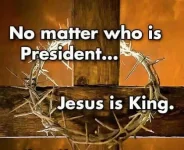
In doing so, Jesus Christ, the Son of God, established himself as the King of the Jews and King of Kings for all mankind… for all time (1 Timothy 1:17; 6:14-16; Hebrews 1:8).
What Does This Mean?
One day, those who have rejected God as King and Jesus as Messiah will know that Christ is King. And on that day, as it is written, “Every knee shall bow to Me, and every tongue shall give praise to God.” (Romans 14:11; Philippians 2:10; Revelations 15:3).