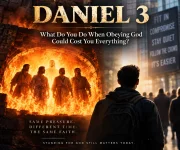
Daniel Chapter 3: What Do You Do When Obeying God Could Cost You Everything?

David

Know the Bible
Admin
Joined
May 13, 2025
Messages
1,270
Reaction score
1,679
Points
113
Age
67
Location
Charlestown, IN
Website
know-the-bible.com
Gender
Male
Country
United States
1790003682046.webpI always thought when reading through Daniel 3 that the fiery furnace wasn't the biggest deal. I think there is more to this story. What would you do if all of your friends were bowing down and you knew that if you would not bow you would be killed.
So Nebuchadnezzar creates this giant image and tells everyone to bow down when they hear the music play. No option to bow in your home and have it be between you and God. This was public. If you didn't bow down you would be cast into the fiery furnace. They didn't.

What I love about this story is that they didn't try to reason with Nebuchadnezzar. They didn't tell him there was another way or try to convince him of something. They just told him that was something they would not do. "Our God whom we serve is able to deliver us out of the burning fiery furnace." Daniel 3:17 Then they go on to say this in the next verse. "But if not, be it known unto thee, O king, that we will not serve thy gods, nor worship the golden image which thou hast set up." Daniel 3:18

"But if not". I think that's what this whole chapter is about. They were willing to obey God no matter if he delivered them or not. They knew that God could deliver them but if he didn't they still weren't going to bow down. That's what faith is all about. Not knowing you will be pulled out of the fire, but refusing to bow whether he delivers you or not.

Nebuchadnezzar got angry and increased the heat of the furnace 7 times hotter. They were cast into the fire but what happened next amazed Nebuchadnezzar. "I see four men loose, walking in the midst of the fire, and they have no hurt." Daniel 3:25 All that fire couldn't harm them. The only thing the fire burned was what was holding them.

In the KJV Nebuchadnezzar says that he saw a man "like the Son of God". In Aramaic it can also mean "a son of the gods". We know that later in this passage in Daniel 3:28 Nebuchadnezzar says that God "sent his angel, and delivered his servants that trusted in him." I don't want to get too far out there and say that it was Christ that was in the fire with them. All we know is that God was there and sent someone to keep them safe.

I believe that's one of the greatest lessons from this chapter. God didn't save them from the fire he saved them in the fire. We all want God to save us from the fire. But sometimes God can be glorified by saving us in the fire as well.

At the end of this chapter Nebuchadnezzar isn't talking about his image he's talking about their God. "Blessed be the God of Shadrach, Meshach, and Abednego... because there is no other God that can deliver after this sort." Daniel 3:28 He created an image to show off his greatness but at the end of this story it was Gods greatness that was shown.

I think that's what Daniel 3 is all about. Did Shadrach, Meshach, and Abednego survive the fire? Yes but what if they didn't know that they would? Would they have still refused to bow?

Its easy to trust God when there is no fire in front of you.
 
What was in the 4th figure that made King Nebuchadnezzar exclaim in Daniel 3:25 that he looked like "a son of the gods"?
The Bible really does not tell us exactly what Nebuchadnezzar saw in that fourth man that made him say, “the form of the fourth is like the Son of God” in ~Daniel 3:25. We need to be careful not to add something to the text that God did not tell us. What we do know is that Nebuchadnezzar had just ordered three men thrown into a furnace that was so hot it killed the men who threw them in. Then he looks into the furnace and sees four men walking around loose, unharmed by the fire. Obviously, he knew he was looking at something supernatural.

The Aramaic wording in Daniel 3:25 can be understood as “a son of the gods” or someone who appeared to be a divine being. Remember, Nebuchadnezzar was still speaking from the perspective of a pagan king. We should not assume that he suddenly understood the fourth man to be Jesus Christ simply because some English translations say “the Son of God.”

In fact, Nebuchadnezzar tells us himself what he believed had happened just a few verses later. ~Daniel 3:28 says, “Blessed be the God of Shadrach, Meshach, and Abednego, who hath sent his angel, and delivered his servants that trusted in him.” So apparently there was something about this fourth person that made Nebuchadnezzar immediately realize that he was not looking at an ordinary man. But Scripture never tells us whether he was glowing, what he was wearing, or what physical feature caused Nebuchadnezzar to react that way.

Could this have been an appearance of Christ before His incarnation? The passage itself never says that. What the text does plainly tell us is that God sent a supernatural messenger into that furnace and delivered His servants who trusted Him. And I think that is really where the emphasis belongs. Daniel 3 is not trying to get us fascinated with what the fourth man looked like. It is showing us the God who sent his angel into the fire with His servants and brought them out without even the smell of fire on them.
 
Rose asks: What is the significance of Daniel's absence in chapter 3?

The truth of the matter is that we don't know where Daniel was during Daniel 3. We shouldn't act like we do. As you can see at the end of Daniel 2 Daniel was placed in a high position. He was appointed to be “ruler over the whole province of Babylon, and chief of the governors over all the wise men of Babylon” ~Daniel 2:48. Daniel asked for his friends to be appointed to positions and “Daniel sat in the gate of the king” ~Daniel 2:49.

Notice that in Daniel 3 the only ones mentioned as being accused of not worshipping the image were Shadrach, Meshach and Abednego. There is no mention of Daniel. We aren't told that he worshipped the image, he didn't worship the image, he was excused from the decree or that he was somewhere else. All of these are speculation.

There may be something that we can learn from Daniel not being there. God didn't need Daniel to be there for these three to stand firm in chapter 3. We saw all four of them together in chapter 1. Chapter 2 Daniel is front and center. But in chapter 3 Shadrach, Meshach and Abednego have to stand on their own.They didn't have to rely on Daniel to show them what to do. They tell Nebuchadnezzar that “our God whom we serve is able to deliver us” and then they state “But if not...we will not serve thy gods” ~Daniel 3:17-18. This is amazing. They knew what they believed because they knew God.

However I don't want to put too much into why Daniel wasn't there. The point of Daniel 3 isn't to ask where was Daniel? It's about what happens when God's people are told to do what God has said not to do. These three chose to go into the fire instead of bowing down and God was honored. That is the focus of this chapter.
 
How does God’s presence with His people differ from simply removing them from every trial?
 
That is an important distinction, Rose. Daniel 3 shows us that God’s presence does not always mean the trial is removed. Shadrach, Meshach, and Abednego were not spared from being thrown into the furnace. They were spared in the furnace.

Their faith was not based on God keeping them from suffering. In fact, they had already said, “our God whom we serve is able to deliver us,” but then added, “But if not...we will not serve thy gods” (Daniel 3:17-18). That is real faith. They trusted God whether He delivered them or not.

Then, once they were in the fire, Nebuchadnezzar saw that they were not alone. Daniel 3:25 says, “Lo, I see four men loose, walking in the midst of the fire, and they have no hurt.” Sometimes God delivers us from the trial. Sometimes He carries us through it. But either way, His people are never abandoned.

That also fits Isaiah 43:2: “When thou walkest through the fire, thou shalt not be burned; neither shall the flame kindle upon thee.” The promise is not that there will never be fire. The promise is that God is with His people in the fire.
 
Any idea why the specific place "the plain of Dura in the province of Babylon" was mentioned? What made Nebuchadnezzar build this statue and when was it probably built?
 
Last edited:
Any idea why the specific place "the plain of Dura in the province of Babylon" was mentioned? What made Nebuchadnezzar build this statue and when was it probably built?
Those are good questions, Rose. What is interesting is that Daniel gives us the location very specifically: “Nebuchadnezzar the king made an image of gold... he set it up in the plain of Dura, in the province of Babylon.” (Daniel 3:1) But Scripture does not tell us why Nebuchadnezzar chose the plain of Dura. Since Daniel specifically records the location, I think we should take it as an actual place where this happened, but anything beyond that about why he chose it would be speculation.

The same thing is true about when the image was built. Daniel does not give us a date or tell us how much time passed between chapters 2 and 3. I do think there is an interesting contrast between the two chapters, though. In Daniel 2, Nebuchadnezzar was told that he was only the head of gold and that other kingdoms would come after him: “Thou art this head of gold.” (Daniel 2:38)

Then in Daniel 3, Nebuchadnezzar makes an entire image of gold and commands everyone to bow before it. Daniel never specifically says that he built the image because of the dream, so I would not state that as fact, but the contrast is certainly hard to miss.

What Scripture does tell us plainly is what happened next. Nebuchadnezzar gathered the rulers of the province together and commanded them to worship the image when the music sounded (Daniel 3:2-6).

That brings us to something I think is important in the chapter. Why do you think Nebuchadnezzar was not satisfied simply with building the image? Why did he also require everyone else to bow down and worship it?
 
Rose, those are some good questions for Daniel 4. Let's hang onto them and come back to them when we get there. I would like for us to finish working through Daniel 3 first so we don't get too far ahead of the text.

Let's go back to the beginning of the chapter for a minute.

Daniel 3:4-6 says:

“Then an herald cried aloud, To you it is commanded, O people, nations, and languages, That at what time ye hear the sound of the cornet, flute, harp, sackbut, psaltery, dulcimer, and all kinds of musick, ye fall down and worship the golden image that Nebuchadnezzar the king hath set up: And whoso falleth not down and worshippeth shall the same hour be cast into the midst of a burning fiery furnace.”

What stands out to me is that Nebuchadnezzar wasn't merely asking people to respect his image. He commanded them to worship it, and everybody was expected to do it at the same time. Then verse 7 tells us that when the music sounded, “all the people, the nations, and the languages, fell down and worshipped the golden image.”

Think about the pressure that created for Shadrach, Meshach, and Abednego. They weren't standing among a large group of people who agreed with them. As far as the text shows us, everybody around them was bowing.

That raises a question I think is worth discussing before we go farther:

How much harder is it to obey God when almost everyone around you is doing the opposite, and does something become acceptable before God simply because nearly everyone else is doing it?
 
Why do you think Nebuchadnezzar was not satisfied simply with building the image? Why did he also require everyone else to bow down and worship it?

Nebuchadnezzar was trying to claim the kind of honor that belongs to God alone. He wanted their visible submission and unquestioned obedience.

How much harder is it to obey God when almost everyone around you is doing the opposite, and does something become acceptable before God simply because nearly everyone else is doing it?

It can be much harder emotionally and socially when nearly everyone around us is going the other way. We may feel isolated, pressured, or even unreasonable for refusing to join in.
 
Why do you think Nebuchadnezzar was not satisfied simply with building the image? Why did he also require everyone else to bow down and worship it?

Nebuchadnezzar was trying to claim the kind of honor that belongs to God alone. He wanted their visible submission and unquestioned obedience.
I think that is probably the right direction, Rose, but I would word it a little more carefully because Daniel 3 does not directly tell us what was in Nebuchadnezzar’s heart. What the text does tell us is that he was not content simply to set up the image. He commanded everyone to “fall down and worship the golden image” and threatened death for anyone who refused (Daniel 3:5-6). So this was more than just building a monument. He demanded outward worship and obedience from everyone under his rule.

That is where the conflict with God becomes clear. The three Hebrews knew that worship belongs to God alone. Their refusal was not merely political resistance. It was obedience to God in the face of a command that required idolatry. I think the safest way to put it is that Nebuchadnezzar demanded the kind of worship and submission that these men knew they could not give without disobeying God.
 
How much harder is it to obey God when almost everyone around you is doing the opposite, and does something become acceptable before God simply because nearly everyone else is doing it?

It can be much harder emotionally and socially when nearly everyone around us is going the other way. We may feel isolated, pressured, or even unreasonable for refusing to join in.
I agree, Rose. That pressure is one of the things Daniel 3 makes very clear. Verse 7 says that “all the people, the nations, and the languages, fell down and worshipped the golden image.” Shadrach, Meshach, and Abednego were standing against what almost everyone else was doing. But the number of people doing something never makes it right before God. Scripture says, “Thou shalt not follow a multitude to do evil” (Exodus 23:2). Truth is not decided by majority vote.

That is part of what makes their stand so powerful. They were not looking around to see what everyone else was doing. They already knew what God had commanded about worship, so even when obedience left them standing almost alone, they would not bow. I think that is a needed reminder for us too. If God has spoken clearly in His Word, the fact that nearly everyone around us accepts something does not change what He said.

Peter’s denial of Jesus also shows how powerful the fear of people can be. He knew who Jesus was, yet under pressure he denied knowing Him (Matthew 26:69-75). It is a good reminder that we need to settle beforehand that obeying God matters more than fitting in or avoiding trouble.
 
I think that's what Daniel 3 is all about. Did Shadrach, Meshach, and Abednego survive the fire?

This is absolutely Amazing, thank you David : )

Yes, Shadrach, Meshach, and Abednego survived the fiery furnace completely unharmed.
According to the biblical account in Daniel 3, King Nebuchadnezzar ordered them thrown into a furnace heated seven times hotter than usual, which was so intense that it killed the soldiers who threw them in. However, they emerged from the flames with not a hair of their heads singed, their robes unaffected, and no smell of fire on their bodies. Daniel 3:27
 
Thanks Rose for posing such interesting questions, which at first glance often seem like simple ones.
Great bible study materials : )
 
Did Shadrach, Meshach and Abednego know that God was with them in the burning furnace?
 
Did Shadrach, Meshach and Abednego know that God was with them in the burning furnace?
Hi Rose, my take (without digging any deeper) is that S, M & A would have known because they survived heat that killed soldiers outside the furnice, and not a hair of their heads was singed. I am only checking in quickly, so will look this up later xxx
 
Last edited:
Did Shadrach, Meshach and Abednego know that God was with them in the burning furnace?
What stands out to me is that Shadrach, Meshach, and Abednego had already made up their minds before they ever went into the furnace. They knew God was able to deliver them, but they did not know for certain that He would. That is why they said, “But if not... we will not serve thy gods” (Daniel 3:18). Then, once they were in the fire, God was with them and delivered them. But Scripture never tells us exactly what they themselves saw or understood while they were in there. The real lesson is that their faith was settled before the deliverance came. They were going to obey God whether He rescued them from the furnace or not.
 
What stands out to me is that Shadrach, Meshach, and Abednego had already made up their minds before they ever went into the furnace. They knew God was able to deliver them, but they did not know for certain that He would. That is why they said, “But if not... we will not serve thy gods” (Daniel 3:18). Then, once they were in the fire, God was with them and delivered them. But Scripture never tells us exactly what they themselves saw or understood while they were in there. The real lesson is that their faith was settled before the deliverance came. They were going to obey God whether He rescued them from the furnace or not.
This is a Powerful Miracle, that seems to have been "overlooked". Now I see why you asked the question Rose : )
The Bible is no doubt full of Incredible "Stories" like this one; they are True, yet overlooked. I am new to Bible Study, so look forward to learning more about the Amazing Things that God did, and man chose to ignore!?
 
What stands out to me is that Shadrach, Meshach, and Abednego had already made up their minds before they ever went into the furnace. They knew God was able to deliver them, but they did not know for certain that He would. That is why they said, “But if not... we will not serve thy gods” (Daniel 3:18). Then, once they were in the fire, God was with them and delivered them. But Scripture never tells us exactly what they themselves saw or understood while they were in there. The real lesson is that their faith was settled before the deliverance came. They were going to obey God whether He rescued them from the furnace or not.
A Beautiful Testimony:
Now if ye be ready that at what time ye hear the sound of the cornet, flute, harp, sackbut, psaltery, and dulcimer, and all kinds of musick, ye fall down and worship the image which I have made; well: but if ye worship not, ye shall be cast the same hour into the midst of a burning fiery furnace; and who is that God that shall deliver you out of my hands?16 Shadrach, Meshach, and Abed–nego, answered and said to the king, O Nebuchadnezzar, we are not careful to answer thee in this matter.17 If it be so, our God whom we serve is able to deliver us from the burning fiery furnace, and he will deliver us out of thine hand, O king.18 But if not, be it known unto thee, O king, that we will not serve thy gods, nor worship the golden image which thou hast set up.19 ¶Then was Nebuchadnezzar full of fury, and the form of his visage was changed against Shadrach, Meshach, and Abed–nego: therefore he spake, and commanded that they should heat the furnace one seven times more than it was wont to be heated.20 And he commanded the most mighty men that were in his army to bind Shadrach, Meshach, and Abed–nego, and to cast them into the burning fiery furnace.21 Then these men were bound in their coats, their hosen, and their hats, and their other garments, and were cast into the midst of the burning fiery furnace.22 Therefore because the king’s commandment was urgent, and the furnace exceeding hot, the flame of the fire slew those men that took up Shadrach, Meshach, and Abed–nego.23 And these three men, Shadrach, Meshach, and Abed–nego, fell down bound into the midst of the burning fiery furnace.24 Then Nebuchadnezzar the king was astonied, and rose up in haste, and spake, and said unto his counsellors, Did not we cast three men bound into the midst of the fire? They answered and said unto the king, True, O king.25 He answered and said, Lo, I see four men loose, walking in the midst of the fire, and they have no hurt; and the form of the fourth is like the Son of God ...
 
Last edited:
Back
Top Bottom