
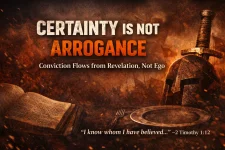
This article is part of the Battle for Truth – Holding the Line series.
Next: What Is Sound Doctrine?
We are living in a time when men apologize for believing what God has plainly said. They bow their heads as though conviction were a character flaw. They speak softly about eternal truths as if clarity itself were sin. But Scripture does not teach us to blush at what God has revealed.
The charge is this: if you are certain, you are proud. If you are firm, you are unloving. If you say, “This is what the Lord has spoken,” you are arrogant.
But what does the Word of God say?
James writes, “For he that wavereth is like a wave of the sea driven with the wind and tossed” ~James 1:6. That is not a commendation. That is a rebuke. A man who wavers is not humble. He is unstable. He is carried by pressure. He is governed by fear. He moves when the wind moves.
Is that what Christ died to produce? Men and women who tremble before culture but not before God?
Paul did not speak with hesitation about the gospel. He said, “I know whom I have believed, and am persuaded that he is able to keep that which I have committed unto him against that day” ~2 Timothy 1:12. That is not the language of ego. That is the language of assurance rooted in the character of God.
Understand this clearly. Biblical certainty is not confidence in self. It is confidence in revelation.
Pride says, “I am right because I am wise.” Faith says, “God is right because He has spoken.” Those are not the same thing. One exalts man. The other bows before Scripture.
When our Lord prayed, “Sanctify them through thy truth: thy word is truth” ~John 17:17, He did not suggest that truth would be fluid. He did not imply that it would require cultural adjustment. He anchored sanctification, holiness, and transformation in something fixed: the Word of God.
If the Word is truth, then affirming it is not arrogance. Denying it is.
You must see the deeper issue. The world does not despise certainty in mathematics. It does not resent certainty in science. It only despises certainty when it confronts sin. When the Word of God exposes rebellion, when it declares that “all have sinned” ~Romans 3:23, and that repentance is commanded, men recoil. And they label conviction as pride to protect their own autonomy.
Paul warned us that a time would come when men “will not endure sound doctrine; but after their own lusts shall they heap to themselves teachers, having itching ears” ~2 Timothy 4:3. The problem is not clarity. The problem is desire. Men do not reject doctrine because it is unclear. They reject it because it confronts them.
And so they call certainty toxic.
But what is the alternative? Shall we become unsure about the nature of God? Shall we hesitate about the exclusivity of Christ? Shall we apologize for the cross? Jesus said, “Heaven and earth shall pass away, but my words shall not pass away” ~Matthew 24:35. That is absolute. That is unyielding. And it comes from the lips of the One who is meek and lowly in heart.
Certainty does not contradict humility. It depends upon it. You cannot be certain about Scripture unless you have humbled yourself beneath it. The proud man edits God. The humble man submits to Him.
If the faith was “once delivered unto the saints” ~Jude 3, then it has content. It has boundaries. It has doctrine. And if it has doctrine, then to define it is not arrogance. It is obedience.
The real question is not whether culture is offended by conviction. The real question is whether we fear God more than we fear men.
A wavering church will produce wavering believers. A church ashamed of certainty will soon be ashamed of Christ.
So do not apologize for standing where God has spoken. Tremble at His Word. Speak it with love. But do not dilute it to avoid criticism.
Net we will press further into what Scripture calls sound doctrine, because certainty without substance is presumption, but certainty grounded in truth is faithfulness.
For those who want to go deeper on this theme of biblical certainty, here is a sermon that strongly reinforces knowing God through His revealed Word. This message is not part of this series, but it aligns well with what we are discussing.
“The essential thing in life is to understand and know God. All other truths and convictions flow from that knowledge.” — Paul Washer
“The Knowledge of God” (audio on SermonIndex)


