Why Did Jesus Breathe On His Disciples ...

Yesua888

Well-known member
Joined
Nov 15, 2025
Messages
502
Reaction score
353
Points
63
1779699266153.webp

The Greek word used for "breathed" in John 20:22 (emphysaō) is the same word used in the Greek translation of the Old Testament (Septuagint) for God breathing life into Adam in Genesis 2:7, highlighting the profound connection between these two events.

The Promise of the Holy Spirit
1779699482788.webp

Jesus personally gave the gift of the Holy Spirit

to each of the disciples the night He made His first post-resurrection appearance.

Well actually, no, He didn’t, but He was about to.

The disciples did not receive the Holy Spirit until the Day of Pentecost, which wouldn’t happen for another fifty days (10 days after Ascention).

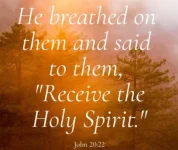
What did Jesus mean when He said, “Receive the Holy Spirit?”​

Jesus could not give the Holy Spirit to anyone, much less the disciples, until after He ascended back to heaven. We know this is true because of what Jesus says in Acts 1:8.

But you will receive power when the Holy Spirit has come upon you.”

The Bible records two distinct events related to the Holy Spirit and the disciples:
  1. John 20:22: On the evening of the day of His resurrection, Jesus appeared to His disciples, said, "Peace be with you. As the Father has sent me, even so I am sending you," and then breathed on them saying, "Receive the Holy Spirit." This act is often interpreted as a symbolic or initial impartation of the Spirit, specifically for the purpose of regeneration and the authority to forgive sins (John 20:23), occurring before His ascension.
  2. Acts 2:1-4: Approximately fifty days after the resurrection (ten days after the Ascension), on the Day of Pentecost, the disciples were gathered together when a sound like a mighty wind filled the house, and tongues of fire rested on each of them. "All of them were filled with the Holy Spirit" and began speaking in other languages. This event fulfilled Jesus' promise in Acts 1:8 that they would "receive power when the Holy Spirit comes on you" and be His witnesses. This is the moment of their public empowerment and the birth of the Church.
The key verses showing the disciples were told to wait for this later power are:
  • Luke 24:49: "I am going to send you what my Father has promised; but stay in the city until you have been clothed with power from on high."
  • Acts 1:4-5, 8: Jesus commanded them not to leave Jerusalem but to wait for "the gift my Father promised ... you will be baptized with the Holy Spirit... But you will receive power when the Holy Spirit comes on you."
This distinction explains the sequence: an initial reception in John 20, followed by the full empowerment for ministry at Pentecost.
What do we know about Holy Spirit?

Why is Holy Spirit sent into Believers?

The Holy Spirit is sent to and descends upon believers at two distinct levels ... the indwelling at the moment of salvation. Biblical accounts in Acts 8:14–17 and Acts 19:1–6 show instances where believers received the Spirit later.

There are several essential purposes, all centered on continuing the work of Jesus and enabling the Christian life:

To Empower for Mission: Jesus stated that the disciples would "receive power when the Holy Spirit has come upon you, and you will be my witnesses" (Acts 1:8). The Spirit provides the supernatural strength, boldness, and gifts (1 Corinthians 12) needed to live a holy life and proclaim the gospel effectively.

To Regenerate and Seal: The Spirit gives new spiritual life (regeneration) and permanently seals believers as God's possession, guaranteeing their salvation (John 3:5-6; Ephesians 1:13-14; Titus 3:5).

To Teach, Guide, and Reveal Truth: As a Helper (Paraclete), The Holy Spirit (called The Spirit of Truth) guides believers "into all truth", teaches them, and helps them understand Scripture "will teach you all things" (John 14:26; 16:13; 1 Corinthians 2:12).
He illuminates Scripture, reveals God's will, and brings conviction of sin, righteousness, and judgment (John 16:8).

To Indwell, Dwell Seal and Assure: The Spirit takes up permanent residence within every believer, making their body His temple (Romans 8:9; 1 Corinthians 3:16; 6:19), marking them as God's possession and sealing them as a "guarantee of our inheritance" (Ephesians 1:13-14, 1 Corinthians 6:19). This provides assurance of salvation and eternal life.

To Transform and Sanctify: The Spirit works within believers to conform them to the image of Christ. This process, called sanctification, involves renewing the mind, overcoming sin, and producing the "fruit of the Spirit" (Galatians 5:22-23) such as love, joy, and peace.

To Comfort and Intercede: As the "Helper" or "Comforter" (Paraclete), the Spirit provides strength and comfort in times of weakness and trial. He also intercedes for believers in prayer when they do not know how to pray (Romans 8:26).

To Produce Fruit and Transform: The Spirit works within to produce the fruit of a Christ-like character (love, joy, peace, etc.) and progressively transforms believers into Christ's image (Galatians 5:22-23; 2 Corinthians 3:18).

To Gift and Equip: The Spirit distributes spiritual gifts to believers for the purpose of building up the Church and serving others (1 Corinthians 12:4-11; Ephesians 4:11-12).

To Empower and Give Power: The Spirit provides power for witnessing, living a holy life, overcoming sin, and performing works for God's kingdom (Acts 1:8; Romans 15:13; Galatians 5:16-18).

1779700834506.webp
 
Last edited:
The Holy Spirit is sent to and descends upon believers at two distinct levels ... the indwelling at the moment of salvation. Biblical accounts in Acts 8:14–17 and Acts 19:1–6 show instances where believers received the Spirit later.
This needs to be corrected because Scripture does not teach two levels of receiving the Holy Spirit, as though a person can belong to Christ at salvation and then later climb into some higher class of Christian by receiving the Spirit again.

That may sound spiritual, but Scripture does not teach it.

Paul draws the line clearly: “Now if any man have not the Spirit of Christ, he is none of his” ~Romans 8:9. That is not complicated. If a man does not have the Spirit, he does not belong to Christ. So we cannot turn around and teach that someone is truly saved, truly in Christ, truly belonging to God, but still waiting for the Holy Spirit in some later second-stage sense.

That is not Bible. That is confusion.

Paul asked the Galatians, “Received ye the Spirit by the works of the law, or by the hearing of faith?” ~Galatians 3:2. The answer is plain. The Spirit is received by faith when the gospel is believed. Ephesians says the same thing: “after that ye believed, ye were sealed with that holy Spirit of promise” ~Ephesians 1:13. The sealing of the Spirit is tied to believing the gospel, not to a later religious experience.

This is where the teaching becomes dangerous.
Once you start teaching “two distinct levels,” it often produces two classes of Christians: the regular believers and the supposedly special Spirit-baptized believers. But the Bible does not divide the body of Christ that way.

The Holy Spirit is not a badge to wear so someone can look more spiritual. He is not a trophy for religious boasting. Jesus said of the Spirit, “He shall glorify me” ~John 16:14. The Holy Spirit glorifies Christ. He does not glorify the person claiming an experience.

If someone walks around acting superior because they say they have been baptized in the Holy Spirit or because they claim to speak in tongues, that is not spiritual maturity. That is flesh wearing church clothes.

Paul had to correct that same spirit in Corinth. They had spiritual gifts, but they were still divided, proud, and carnal. He told them, “For ye are yet carnal: for whereas there is among you envying, and strife, and divisions, are ye not carnal” ~1 Corinthians 3:3. Their gifts did not prove maturity. Their pride proved the opposite.

And right in the middle of correcting their confusion over spiritual gifts, Paul says, “Charity vaunteth not itself, is not puffed up” ~1 Corinthians 13:4. That means if someone uses spiritual gifts to boast, elevate himself, or make other believers feel lesser, he is already walking contrary to the very love Scripture commands.

Tongues were never given so someone could parade himself around as an elite Christian. Paul asked, “Do all speak with tongues?” ~1 Corinthians 12:30. The implied answer is no. So anyone who makes tongues the proof of being Spirit-filled is contradicting Scripture.

Acts 8 and Acts 19 must be handled in context. Acts is recording a unique transition in redemptive history as the gospel moves from Jerusalem to Samaria and then outward. Those moments publicly confirmed that the same Holy Spirit was given as the gospel spread. They are not a universal pattern teaching that Christians today receive the Spirit in two installments.

Acts 19 is especially clear. Those men had only known John’s baptism. Paul asked them, “Unto what then were ye baptized?” and they said, “Unto John’s baptism” ~Acts 19:3. That was not a normal group of New Testament believers who had salvation but lacked a second level of the Spirit. They needed the fuller gospel concerning Christ.

So let the doctrine be stated plainly: every true believer has the Holy Spirit. The Spirit indwells, seals, sanctifies, teaches, convicts, comforts, gifts, and empowers the believer. But Scripture does not teach a two-level Christianity where some believers have salvation and others have the “real” Holy Spirit experience.

Now, there are repeated fillings of the Spirit for boldness, obedience, service, and witness. Acts 4:31 says, “they were all filled with the Holy Ghost, and they spake the word of God with boldness.” But repeated filling is not the same thing as receiving the Spirit as a second stage after salvation.

We also need to be fair. Not everyone using this language has evil motives. Some people are simply repeating bad teaching they were handed. But if the result is boasting, self-display, spiritual superiority, or making other believers feel like second-class Christians, that is not the fruit of the Spirit.

The fruit of the Spirit is “love, joy, peace, longsuffering, gentleness, goodness, faith, meekness, temperance” ~Galatians 5:22-23. A truly Spirit-filled person points people to Christ, submits to Scripture, walks humbly, and builds up the body. He does not use spiritual language to make himself look special.

The biblical line is simple: if a person is in Christ, he has the Spirit. If he does not have the Spirit, he is not Christ’s. That is not tradition. That is Scripture.
 

Latest Profile Posts

The Bible is not on trial. Man is. Jesus said, “the scripture cannot be broken” ~John 10:35. God’s Word does not bow before modern skepticism. It exposes the heart and stands forever. The question is not whether Scripture will stand. It will. The question is whether we will stand with it.
When God warns you, don’t brush it off. Answer Him while you still can, because a hardened heart doesn’t stay neutral, it moves toward judgment. Scripture is clear: “Today if ye will hear his voice, harden not your hearts” ~Hebrews 3:15, and again, “He, that being often reproved hardeneth his neck, shall suddenly be destroyed, and that without remedy” ~Proverbs 29:1.
We must be careful not to cater to people's carnal desires, but rather point them to God.

Online statistics

Members online
0
Guests online
207
Total visitors
207

Invite Others

🔗 Invite a Friend

Know someone who loves the Bible? Invite them to join us at Biblical Truth Forum — a place where God's Word comes first.

Join Now

Truth matters. Help us build something grounded in Scripture.

Members online

No members online now.
Back
Top