

David
Know the Bible
- Joined
- May 13, 2025
- Messages
- 846
- Reaction score
- 808
- Points
- 93
- Age
- 67
- Location
- Charlestown, IN
- Website
- know-the-bible.com
- Gender
- Male
- Country
- United States
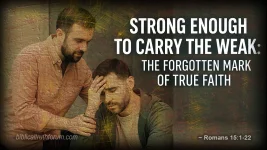
“We who are strong ought to bear the infirmities of the weak, and not to please ourselves.”
~ Romans 15:1
We live in a “me” culture, but the Bible says to the strong, “Bear the weak.” God calls His children to bear one another, not to flex their freedom. Romans 15 is not a pep talk. It’s a gut punch to those with a thin veneer of faith and a self-absorbed life. Don’t misunderstand the application: the verses are not about supporting false converts or coddling the unsaved. The ones we bear are new or weaker born-again believers.
We live in a self-pleasing, strength-flexing, rights-claiming culture. And the Word of God calls us to a far better way: bearing with the weak, building one another up, and boldly declaring Christ to the Christ-less. This is no tepid text. Romans 15 is an urgent call to the fullness of the gospel, the unity of the Body, and the mission of God. And Paul doesn’t mince words.
“We who are strong have an obligation to bear with the failings of the weak, and not to please ourselves” (Romans 15:1). This isn’t a suggestion. This is a responsibility. Spiritual strength is not proven by how loudly we talk or how right we are or how independent we can live. It is proven by how patiently we walk alongside others as they journey, especially the weaker members of the Body. It is not found by boasting of our liberty, but by loving our brother (1 Corinthians 8:9).
Paul points us to the example of Christ. Jesus lived for the glory of God and never once lived for the sake of pleasing Himself, though He could have. “The reproaches of those who reproached you fell on me” (Romans 15:3). Jesus bore our insults, our shame, and our sin. Deliberately. Willingly. That is the nature of love. It lays down self to serve.
Such a mind-set only comes when you’re grounded in the Scriptures. Paul says that all that “was written in former days was written for our instruction, that through endurance and through the encouragement of the Scriptures we might have hope” (Romans 15:4). This is not poetry. This is practical application. In the dark days, when people let you down, when life is hard, when you just want to give up, it is the Word of God that will be the fuel for your endurance and the restorer of your hope.
And do you see the glorious vision Paul holds before us? Harmony. Not just getting along, but living “in accord with Christ Jesus” (v. 5) to the point where with one voice we magnify the God of our glory. And this unity is not built on compromise, but on Christ. It is fueled by grace, driven by truth, and empowered by the Spirit. “Welcome one another as Christ has welcomed you, for the glory of God” (v. 7). This is the standard: Christ’s welcome. Not partial, not suspicious, not conditional. Full acceptance in truth and love.
Then Paul points us to something even greater. He widens our vision. Christ did not just come for the Jews. He came so that “the Gentiles might glorify God for his mercy” (v. 9). Do you see how Paul is stringing these Old Testament promises together? Look at the cross-references. Psalm 18:49, Deuteronomy 32:43, Psalm 117:1, Isaiah 11:10. God’s mercy would reach to the ends of the earth. And Paul now shows how those scattered Old Testament promises find their glorious consummation in Christ.
Do you understand why Paul wrote so boldly? He says, “On some points I have written to you very boldly by way of reminder” (Romans 15:15). This wasn’t Paul being arrogant. This was grace-fueled boldness. Paul knew who called him, and he was not afraid of the gospel. He did not dilute it, tone it down, make it easy for people to swallow. He was not afraid to confront, to challenge, to correct, because eternity is at stake.
He had learned his mission. He was “a minister of Christ Jesus to the Gentiles, doing the priestly service of the gospel of God, so that the offering of the Gentiles may be acceptable, sanctified by the Holy Spirit” (v. 16). Paul wasn’t seeking converts to a religion. He was boldly preaching salvation through Christ that leads to obedience and holiness by the Spirit. And he had no intention of boasting in anything except what Christ had done by his word, deed, and the power of the Holy Spirit (v. 18–19).
Paul’s goal? “Preach the gospel where Christ has not been named, so that I may not build on someone else’s foundation” (vv. 20–21). Preach where Christ hasn’t been named. Build where no one else has built. Reach the unreached. That is the call: “Those who have never been told of him will see, and those who have never heard will understand” (v. 21).
This is not tame, watered-down, casual Christianity. This is a bold call to humble strength, sacrificial love, and relentless mission. It is a gospel that will never coddle pride or allow comfort-driven life-styles. It is all-in because it is worth everything.
If you are strong in the faith, then prove it. Not by boasting, but by bearing. Not by demanding, but by serving. And do it all for the glory of the God and Father of our Lord Jesus Christ. That is what Paul lived for, and that is what we are called to live for as well.

